

Most people are familiar with lasers: green laser beams for stage lighting, red laser pointers for positioning, and invisible industrial laser beams for material processing. Unlike ordinary white light, lasers come in various colors and deliver different processing performances. The core factor that differentiates laser color and functionality is the laser wavelength.
Ordinary white light is a mixture of multiple light waves with different wavelengths. In contrast, a laser is a pure monochromatic light source with a fixed single wavelength. The variation in laser wavelength directly changes laser color, light energy, focus accuracy, and thermal effect, enabling diverse applications across industry, medical treatment, and scientific research.
Laser wavelengths falling within the visible spectrum produce colorful beams recognizable by the human eye, while wavelengths beyond the visible range generate invisible yet high-energy laser light for professional and industrial use.

Visible Laser Wavelengths: Red, Green, Blue, Yellow, & Violet Lasers
Red Laser (635nm – 650nm)
Red laser features excellent visibility and stable performance, making it the most common visible laser in daily use. It is widely adopted in laser pointers, distance meters, and instrument positioning systems. Medically, 630nm red laser assists in blood circulation promotion, pain relief, and basic skin therapy, serving as a practical auxiliary light source for healthcare and precision positioning.
Green Laser (515nm – 532nm)
With higher brightness and stronger penetration than red laser at the same power level, green laser stands out in visual presentation. It is commonly used for stage lighting, outdoor landmark illumination, and large-scene visual effects. Meanwhile, its high precision enables extensive applications in industrial positioning, microscope imaging, high-precision detection, and high-energy scientific experiments.

Blue Laser (445nm – 450nm)
Blue laser is favored for fine engraving and cutting due to its superior optical characteristics. Optimized by professionallaser wavelength design, it focuses into an ultra-tiny spot with high energy density, far exceeding red and green lasers in precision processing. The 450nm blue laser module is the mainstream configuration for desktop engraving and small-scale cutting devices, also widely used in data storage, Blu-ray discs, and medical microscopic imaging.
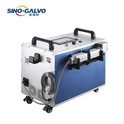
Related Products: Sino Galvo 450nm blue laser module

Yellow Laser (577nm – 594nm)
Yellow laser is a special and high-precision light source with unique visual features, appearing bright yellow from a distance and orange up close. It is rarely used for civilian decoration but dominates high-end precision fields such as precision measurement, micro-imaging, and optical interference research. Specifically, the 593.5nm yellow laser can relieve eye fatigue and support corneal minimally invasive surgery in ophthalmic medical treatment.
Blue-Violet Laser (405nm – 435nm)
As a transition light source between visible light and ultraviolet spectrum, blue-violet laser has a short wavelength and concentrated energy. Compact and portable, it is widely applied in precision laser indicators, small-scale detection equipment, and anti-counterfeiting marking scenarios.
Invisible Industrial Laser Wavelengths: Infrared & Ultraviolet Laser
The most powerful and industrially practical lasers rely on invisible wavelengths. Although undetectable by human eyes, these lasers deliver stable, high-precision, and high-efficiency processing capabilities, becoming the core light sources for modern manufacturing and scientific research.
Infrared Laser (780nm – 1064nm)
Infrared laser with typical wavelengths of 780nm, 808nm, and 1064nm is invisible to the human eye. The 1064nm infrared laser is the core light source of commercial fiber laser marking machines. Featuring prominent thermal effects and strong penetrating power, it is the primary solution for metal engraving, deep ablation, and hardware precision processing. It also covers biological detection, non-contact measurement, and chemical analysis.Note: Invisible infrared laser poses potential eye risks; professional protective glasses are mandatory during operation.
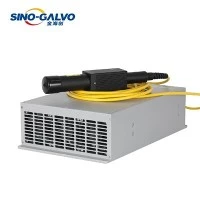
Related Products: SINO GALVO W-Series 50w Q-Switched Pulsed Fiber Lasers

Ultraviolet Laser (266nm – 355nm)
Ultraviolet laser owns the shortest laser wavelength and highest photon energy among common industrial lasers, featuring unique cold processing performance. Different from traditional thermal ablation processing, it processes materials by breaking molecular bonds instead of high-temperature burning, leaving smooth, carbon-free, and deformation-free edges. It is widely used in lithography, micro-nano processing, PCB precision marking, glass and ceramic engraving, and thermal-sensitive material processing, supporting ultra-precision manufacturing requirements.
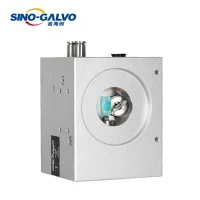
Related Products: Sino Galvo 355nm Solid-State UV Laser With Water Cooling
Sino Galvo 355nm Solid-State UV Laser With Air Cooling

Conclusion: Laser Wavelength Determines Laser Performance
Laser wavelength is the core gene of all laser sources. It not only defines laser color but also determines key performances including energy intensity, thermal effect, focusing accuracy, and material compatibility.
To sum up the application positioning of common laser wavelengths:
- Red laser: Professional for positioning indication and physical therapy
- Green laser: Ideal for high-brightness positioning and scientific detection
- Blue laser: Specialized in fine engraving and small-scale material cutting
- Infrared laser: Dominant in industrial metal deep processing and mass production
- Ultraviolet laser: Exclusive for ultra-precision cold micro-processing
With the continuous upgrading of laser wavelength regulation technology, laser application scenarios are constantly expanding, bringing innovative solutions for industrial upgrading, medical development, and advanced scientific research.
Safety Tips: All lasers with different wavelengths carry optical radiation risks. Never look directly at laser beams. Always wear wavelength-matched professional protective eyewear to ensure standardized and safe operation.
FAQ
Q: What is laser wavelength, and what does it determine?
A: Laser wavelength refers to the fixed optical wavelength of a monochromatic laser beam. It is the core factor that determines laser color, energy density, thermal effect, focusing accuracy, and material compatibility. Different laser wavelengths completely change the laser's processing performance and application scenarios.
Q: Why do different laser wavelengths have different colors?
A: Lasers are pure monochromatic light with a single fixed wavelength. Visible laser wavelengths (405nm–650nm) correspond to red, green, blue, yellow, and blue-violet colors visible to the human eye, while infrared and ultraviolet laser wavelengths fall outside the visible spectrum, producing invisible laser beams.
Q: What are the common types of industrial laser wavelengths and their uses?
A: Common industrial laser wavelengths cover multiple bands: 445–450nm blue laser for fine engraving and cutting; 515–532nm green laser for high-precision positioning and detection; 1064nm infrared laser for metal deep processing; 266–355nm ultraviolet laser for ultra-precision cold processing of sensitive materials.
Q: How does laser wavelength affect laser processing accuracy?
A: Shorter laser wavelengths feature higher photon energy and smaller focusable spot size, delivering higher processing precision. For example, short-wavelength UV lasers achieve micron-level micro-processing with zero thermal damage, while longer-wavelength infrared lasers are more suitable for high-efficiency thermal processing and metal ablation.
Q: Are invisible laser wavelengths more dangerous than visible lasers?
A: Infrared and ultraviolet invisible laser wavelengths pose higher potential risks. Since human eyes cannot detect these beams, users may ignore exposure risks. They can cause invisible damage to eyes and skin, so professional wavelength-matched protective eyewear is required for operation.