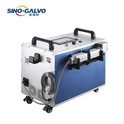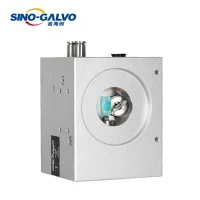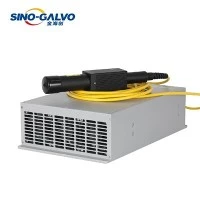


When it comes to laser engraving, custom cutting, and industrial precision marking, 450nm laser and 1064nm fiber laser are two commonly used laser sources in professional galvanometer scanning systems. Whether for DIY engraving machines, customized processing equipment, or industrial mass-production marking systems, selecting the right laser source directly affects processing accuracy, material compatibility, and long-term system stability.
Choosing between a high-performance 450nm blue laser module and a stable 1064nm Q-switched pulsed fiber laser requires a clear understanding of their wavelength characteristics, optical performance, and suitable applications.
By comparing the differences between 450nm laser and fiber laser, equipment integrators, manufacturers, and end users can select a laser source that better matches their processing requirements, production goals, and application environments.
Basic Hardware & Optical Parameter Comparison: 450nm Laser and Fiber Laser
450nm Blue Laser Module (5W/10W/20W)
The 450nm laser is a continuous-wave blue semiconductor laser module specially optimized for high-precision engraving, fine cutting, and customized small-batch processing applications. This 450nm laser series offers three mainstream power options: 5W, 10W, and 20W, covering lightweight surface marking, detailed engraving, and medium-thickness material cutting tasks.
Supporting dual PWM and TTL control signals, the 450nm laser provides flexible power adjustment and fast on-off switching capability. This allows easy integration with mainstream engraving control boards while simplifying system setup, parameter adjustment, and automated processing control.
One of the most significant advantages of the 450nm laser is its visible blue laser beam. Unlike invisible infrared laser sources, the 450nm laser beam can be directly observed by the human eye, eliminating the need for an additional red pointer during positioning.
This visible wavelength greatly improves alignment efficiency during sample testing, machine calibration, and processing preparation.
Thanks to optimized optical design, the 450nm laser delivers an ultra-small focus spot and extended depth of field. Its minimum focus spot reaches 0.03×0.12mm, enabling fine engraving details, clean cutting edges, and consistent processing results on uneven or curved surfaces.
In terms of electrical performance, the 5W and 10W 450nm laser modules adopt a 12V low-voltage power supply, while the high-power 20W 450nm laser version uses a 24V voltage supply.
The operating current ranges from 1.6A to 2.9A, providing low power consumption and efficient energy utilization. The 450nm laser module supports a wide storage temperature range from -40℃ to 85℃, offering excellent environmental adaptability.
With its compact design and simple integration requirements, the 450nm laser is suitable for DIY engraving machines, portable laser processing equipment, and small customized manufacturing systems.
1064nm Q-Switched Pulsed Fiber Laser (20W/30W/100W)
The 1064nm fiber laser is an industrial-grade Q-switched pulsed laser source designed for high-precision metal processing, industrial marking, and scientific research applications.
With a stable center wavelength of 1064±5nm, this fiber laser emits invisible near-infrared light and requires optional red guiding laser assistance for accurate positioning and processing path alignment.
Compared with the 450nm laser, the fiber laser focuses more on high-energy pulse output, processing consistency, and long-term industrial operation stability.
The 1064nm fiber laser provides superior optical performance for industrial applications. It achieves excellent beam quality with M²<1.6 and beam ellipticity higher than 90%, ensuring concentrated and uniform laser energy delivery.
This fiber laser supports adjustable pulse repetition rates from 20kHz to 200kHz and 10%–100% full-range linear power adjustment. Equipped with ultra-fast signal response (ON delay<200μs, OFF delay<100μs), the fiber laser enables high-speed marking, repeatable processing, and precise deep engraving for demanding industrial production environments.
Built for continuous industrial operation, the 1064nm fiber laser adopts a full air-cooled structure equipped with a variable-frequency cooling fan. The cooling system automatically adjusts fan speed according to operating temperature, achieving efficient heat dissipation while reducing operating noise.
It operates stably within a working temperature range of 0℃–40℃. Its factory-sealed core structure provides maintenance-free operation and reduces long-term maintenance costs.
With standard DB25 and TCP/IPv4 Ethernet interfaces, TTL modulation support, emergency stop protection, and multi-channel alarm output, the fiber laser can be easily integrated into automated production lines and precision industrial equipment.
Material Adaptability & Processing Mechanism: Core Differences Between 450nm Laser and Fiber Laser
The fundamental performance difference between 450nm laser and 1064nm fiber laser comes from the different absorption characteristics of various materials at different laser wavelengths.
Because material absorption directly affects laser energy conversion efficiency, heat distribution, and processing quality, the wavelength selection determines whether a laser source is more suitable for non-metal engraving, coated surface processing, or industrial metal machining.
450nm Laser: Best Choice for Non-Metals & Coated Metal Processing
The 450nm blue laser wavelength provides extremely high absorption efficiency for many common non-metal materials, including wood, acrylic, leather, plastic, paper, stone, and plant-based materials.
Compared with infrared laser sources, the shorter wavelength of the 450nm laser allows more efficient energy absorption on many organic and non-metallic materials, resulting in cleaner processing performance.
The 450nm laser can precisely cut materials such as wood, cardboard, and acrylic with thicknesses ranging from 3mm to 20mm, producing smooth cutting edges with minimal burr formation.
By using a low-temperature surface vaporization processing mechanism, the 450nm laser creates a smaller heat-affected zone, effectively reducing problems such as material discoloration, burning, and thermal deformation.
This advantage makes the 450nm laser highly suitable for applications requiring detailed surface processing, including personalized engraving, artistic customization, and precision cutting of delicate materials.
Beyond non-metal applications, the 450nm laser also provides advantages when processing coated metal surfaces.
Traditional infrared laser sources may encounter challenges when processing painted or coated metals due to lower absorption efficiency. The 450nm laser improves energy absorption on coated surfaces, making it suitable for paint removal, surface pattern engraving, and fine marking on painted metal, aluminum, and stainless steel surfaces.
However, because the 450nm laser mainly operates in continuous-wave output mode, it cannot generate the extremely high peak pulse energy required for deep metal engraving.
Therefore, while the 450nm laser performs exceptionally well on non-metals and coated materials, it is not designed as a replacement for fiber laser systems in permanent bare metal marking applications.
1064nm Fiber Laser: Professional Industrial Solution for Bare Metal Machining
Core Advantages & Application Scenarios of 450nm Laser and Fiber Laser
450nm Laser: Ultra-Fine, Low-Damage Custom Processing
Core Advantages of 450nm Laser:
The 450nm laser provides multiple advantages, including visible blue light for convenient positioning, an ultra-small focus spot for detailed engraving, an extended depth of field for processing uneven surfaces, minimal thermal impact, and broad compatibility with non-metal materials.
Compared with traditional infrared laser sources, the 450nm laser offers better absorption performance on many non-metal materials, helping achieve cleaner edges, finer details, and lower heat-related damage during processing.
With low power consumption and simple integration features, the 450nm laser delivers an effective balance between precision, flexibility, and cost efficiency.
These characteristics make the 450nm laser an ideal solution for civilian applications, customized manufacturing, and small-batch production environments where processing detail and surface quality are highly important.
Typical 450nm Laser Applications:
The 450nm laser is widely used for DIY personalized engraving, artistic craft processing, small-batch prototype production, wood and leather engraving, plastic surface marking, acrylic precision cutting, and paint removal on coated metal parts.
Due to its compact structure and easy integration, the 450nm laser is commonly installed in portable engraving machines, desktop laser engravers, and customized processing equipment.
1064nm Fiber Laser: High-Stability Industrial Mass Production Processing
Core Advantages of 1064nm Fiber Laser:
The fiber laser is designed for demanding industrial applications that require high stability, strong pulse energy, and long-term continuous operation.
Its main advantages include excellent beam quality, high peak pulse energy, permanent metal marking capability, deep engraving performance, maintenance-free operation, and compatibility with automated industrial control systems.
Unlike the 450nm laser, which focuses more on fine processing of non-metal materials, the fiber laser is optimized for high-efficiency metal processing and standardized industrial production.
The fiber laser provides consistent processing results during long production cycles, making it suitable for applications requiring repeatability, durability, and strict quality control.
Typical Fiber Laser Applications:
The fiber laser is widely applied in precision marking and deep engraving of 3C electronic components, automotive parts, new energy battery accessories, precision molds, and medical metal devices.
In addition, the fiber laser is suitable for laboratory research and industrial testing applications that require stable laser output and precise material processing.
With excellent reliability and production consistency, the fiber laser has become one of the most widely adopted laser sources for industrial metal marking and manufacturing applications.
Professional Selection Guide: 450nm Laser vs 1064nm Fiber Laser
The following simplified table clearly shows the differences and selection criteria between a 450nm laser and a 1064nm fiber laser based on processing materials, advantages and production scenarios:
|
Item |
450nm Laser |
1064nm Fiber Laser |
|
Main Materials |
Wood, acrylic, leather, plastic, paper, coated metal |
Bare metals: stainless steel, aluminum, alloy, plated metal |
|
Processing Strength |
Ultra-fine engraving, minimal thermal damage, clean cutting edges |
Permanent marking, deep engraving, strong metal penetration |
|
Key Benefits |
High precision, flexible customization, low equipment cost |
High stability, high pulse energy, durable industrial performance |
|
Typical Uses |
Crafts, non-metal fine marking, coated metal processing |
Metal traceability, hardware marking, deep metal engraving |
Important Matching Note: Galvanometer scanners, F-theta lenses and protective optics for 450nm laser and 1064nm fiber laser systems are wavelength-specific and cannot be interchanged. Always choose wavelength-matched optical parts to maintain excellent beam quality, high processing accuracy and long service life of your laser system.