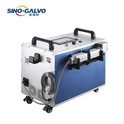


1. What Is Metal Laser Cutting?
Metal laser cutting is a widely used non-contact thermal cutting process in modern metal fabrication and sheet metal manufacturing. It uses a high-energy laser beam generated by a laser source and focuses the beam into a small spot, typically around 0.1–0.3 mm in diameter, through an optical system.
The concentrated laser energy rapidly heats the metal surface within a very short time, causing the material to melt or even vaporize. During the cutting process, high-pressure assist gas is delivered through the cutting nozzle to remove molten metal and improve cutting quality.
Different assist gases are selected according to the characteristics of different metals:
Oxygen is mainly used for carbon steel cutting. The oxidation reaction between oxygen and heated metal generates additional heat, improving cutting speed and making it suitable for medium and thick steel plates.
Nitrogen is commonly used for stainless steel, aluminum alloys, and other metals requiring high-quality cutting surfaces. As an inert gas, nitrogen prevents oxidation and helps achieve smooth and clean cut edges.
Compressed air is often used for thin metal sheet cutting where cost efficiency is a priority.
The entire metal laser cutting process is controlled by a laser cutting control system. Based on CAD drawings, the system precisely controls the movement of the laser cutting head or worktable to follow programmed paths and produce complex contours, holes, and customized metal components.
Currently, fiber laser cutting technology has become the mainstream solution in industrial metal processing. Compared with traditional CO₂ laser cutting systems, fiber laser technology provides higher energy efficiency, lower maintenance requirements, and wider material compatibility. It can process common metals such as carbon steel, stainless steel, aluminum, and galvanized steel.
Compared with traditional mechanical cutting, plasma cutting, and flame cutting, metal laser cutting offers several advantages, including narrow kerf width, high cutting accuracy, small heat-affected zones, and excellent edge quality. Since it is a non-contact process, there is no tool wear and minimal mechanical deformation, reducing the need for additional finishing.
In addition, metal laser cutting provides excellent production flexibility. Manufacturers can quickly modify CAD designs without changing tooling, making it suitable for customized production, small-batch manufacturing, and complex metal components.
Today, metal laser cutting is widely used in automotive parts, industrial machinery, elevator manufacturing, kitchen equipment, electrical enclosures, and metal decorative products.
However, metal laser cutting also has certain limitations. The initial investment cost of a metal laser cutting machine can be high, and highly reflective metals such as copper and brass require special processing technologies. For extremely thick metal plates, traditional cutting methods may still offer advantages in certain applications.
2. Types of Metal Laser Cutting Processes
The metal laser cutting process can be classified according to cutting mechanisms and laser source technologies. Different cutting methods are selected based on material properties, thickness requirements, cutting speed, and surface quality expectations.
2.1 Laser Fusion Cutting
Laser fusion cutting is the most commonly used process in modern metal fabrication.
During this process, a high-power laser beam rapidly heats the metal until it reaches a molten state. High-pressure inert gas, usually nitrogen, is then used to remove the molten material from the cutting area.
Because oxidation is minimized, the finished edges usually have excellent surface quality, with smooth cutting surfaces and little to no oxide layer.
Laser fusion cutting is widely used for stainless steel, aluminum alloys, copper alloys, and other metals requiring high-quality finishes. It is commonly applied in precision sheet metal fabrication, electronic enclosures, medical equipment, and high-end industrial components.
2.2 Laser Oxygen Cutting
Laser oxygen cutting, also known as oxidation cutting, is mainly used for carbon steel processing.
The laser beam first heats the metal to its ignition temperature. Oxygen is then introduced to react with the heated material, creating additional heat through oxidation and accelerating the cutting process.
Compared with inert gas cutting, oxygen cutting provides higher cutting speeds and lower gas costs, making it suitable for medium and thick carbon steel plates.
However, oxidation during the cutting process may create oxide layers on the cutting edge and increase the heat-affected zone. Therefore, additional finishing may be required for applications with strict surface quality requirements.
2.3 Laser Vaporization Cutting
Laser vaporization cutting uses extremely high laser power density to directly vaporize metal materials.
The generated metal vapor is removed by assist gas, forming a narrow cutting path. Because this process requires very high energy input and has relatively high operating costs, its industrial applications are limited.
It is mainly used for ultra-thin metal sheets, micro-precision components, and specialized manufacturing applications.
2.4 Laser Scribing and Controlled Fracture Cutting
Laser scribing and controlled fracture cutting are mainly used for brittle materials such as ceramics, silicon wafers, and glass.
The process uses laser energy to create controlled grooves on the material surface. Thermal stress or external force then causes the material to break along the designed path.
Since most metals have good toughness and ductility, this technology is rarely used for conventional metal laser cutting applications.
2.5 Fiber Laser Cutting
Fiber laser cutting is currently the dominant technology in industrial metal processing.
A fiber laser cutting machine uses optical fibers to transmit laser energy and provides:1. High photoelectric conversion efficiency 2.Lower energy consumption 3. Reduced maintenance requirements 4. Excellent beam quality 5. Wide material compatibility
Fiber laser cutting technology is widely used in modern metal laser cutting applications because it can efficiently process carbon steel, stainless steel, aluminum alloys, copper, and other industrial metals.
2.6 CO₂ Laser Cutting
CO₂ laser cutting technology was once one of the most important solutions for industrial laser processing.
It provides good beam quality and was widely used for metal cutting in earlier applications. However, compared with fiber laser systems, CO₂ lasers have higher energy consumption, more complex maintenance requirements, and lower conversion efficiency.
With the development of fiber laser technology, CO₂ laser systems are now more commonly used for non-metal materials such as wood, plastic, and acrylic.
2.7 Solid-State Laser Cutting (YAG / Disk Laser)
Solid-state laser cutting includes technologies such as YAG lasers and disk lasers.
Traditional YAG lasers were previously used for metal precision processing but have gradually been replaced by fiber lasers due to lower efficiency and higher maintenance requirements.
Disk lasers, as high-power solid-state laser systems, are still used in some specialized applications requiring high power and precision.
3. Materials Suitable for Metal Laser Cutting
Metal laser cutting has excellent material compatibility and can process a wide range of industrial metals, including carbon steel, stainless steel, aluminum alloys, titanium alloys, and some copper alloys.
However, different metals have different melting points, thermal conductivity, reflectivity, and chemical properties. These factors directly affect cutting difficulty, processing efficiency, and final cut quality.
In practical applications, material selection should consider factors such as material type, thickness, laser power, assist gas, and equipment configuration.
3.1 Carbon Steel
Carbon steel is one of the most widely used materials in metal laser cutting due to its excellent laser absorption and stable cutting performance.
During processing, oxygen is commonly used as the assist gas. The oxidation reaction increases cutting speed, making it suitable for medium and thick carbon steel plates.
For applications requiring better edge quality, nitrogen-assisted cutting can reduce oxidation and improve surface finish.
3.2 Stainless Steel
Stainless steel is a common material used in precision sheet metal fabrication, food equipment, medical devices, kitchen equipment, electrical enclosures, and decorative structures.
Nitrogen is commonly used during stainless steel cutting to prevent oxidation and maintain smooth, clean cutting edges.
With high precision and low thermal deformation, metal laser cutting is ideal for complex stainless steel components.
3.3 Aluminum Alloy
Aluminum alloys are widely used in aerospace, automotive, and industrial manufacturing due to their lightweight, high strength, and corrosion resistance.
However, aluminum has higher reflectivity and thermal conductivity compared with steel, making it more challenging to cut.
Proper laser power, focus position, and cutting parameters are required to reduce burr formation and achieve stable cutting quality.
3.4 Titanium Alloy
Titanium alloys are widely used in aerospace, medical equipment, and high-performance industrial applications.
Because titanium can react with oxygen and nitrogen at high temperatures, inert gas protection is often required during metal laser cutting to reduce oxidation.
With proper process parameters, titanium alloys can be cut with high precision and excellent edge quality.
3.5 Copper and Copper Alloys
Copper and brass are highly reflective metals with excellent thermal conductivity, making them more difficult to process compared with steel.
The development of high-power fiber laser technology has improved copper cutting capability. However, these materials still require higher laser power, optimized parameters, and proper protection against reflected laser energy.
3.6 Metals That Are Difficult to Cut with Laser
Some metals are difficult to process due to their physical characteristics.
Highly reflective metals such as gold and silver reflect a large amount of laser energy, making them unsuitable for conventional metal laser cutting without specialized equipment.
In addition, some alloys containing high levels of volatile elements such as zinc or lead may generate excessive fumes and affect cutting quality. For example, galvanized steel can be laser cut, but zinc vapor may contaminate nozzles and optical components, requiring proper ventilation and process control.
4. Advantages of Metal Laser Cutting
Metal laser cutting has become an essential technology in modern manufacturing due to its high precision, efficiency, flexibility, and automation capabilities.
4.1 Non-Contact Processing and Minimal Deformation
Metal laser cutting uses a focused laser beam as the cutting tool, without direct physical contact with the workpiece.
As a result, there is no tool wear or mechanical stress during processing, reducing deformation risks and making it suitable for thin sheets, precision parts, and complex structures.
4.2 High Cutting Accuracy and Stable Quality
Metal laser cutting provides excellent positioning accuracy and repeatability.
The narrow kerf width and small heat-affected zone help produce smooth edges, consistent dimensions, and high-quality finished parts.
This makes it suitable for precision applications such as automotive components, electronic enclosures, and high-end mechanical parts.
4.3 High Efficiency and Flexible Manufacturing
Modern metal laser cutting machines are controlled by CNC systems and CAD/CAM software, enabling automated production with minimal manual operation.
Because no dedicated tooling is required, manufacturers can quickly switch between different designs, making laser cutting ideal for customized production and small-to-medium batch manufacturing.
4.4 High Material Utilization and Lower Processing Costs
The narrow cutting width reduces material waste, while automatic nesting software can further improve sheet utilization.
Since laser-cut edges usually require less grinding and finishing, manufacturers can reduce labor costs and improve production efficiency.
4.5 Wide Application Range
Metal laser cutting is widely used in:
Automotive manufacturing
Industrial machinery
Elevator equipment
Kitchen equipment
Electrical cabinets
Precision sheet metal fabrication
Metal decorative products
Conclusion
Metal laser cutting has become one of the most important technologies in modern metal fabrication.
With advantages including high precision, fast processing speed, excellent flexibility, and broad material compatibility, metal laser cutting provides efficient solutions for processing carbon steel, stainless steel, aluminum alloys, titanium alloys, copper, and other industrial metals.
With continuous development in fiber laser technology, automation systems, and intelligent manufacturing, metal laser cutting will continue to play an important role in precision manufacturing and industrial production.
FAQ
Q: 1. What is metal laser cutting and how does it work?
A: Metal laser cutting is a CNC non-contact thermal fabrication process. It uses focused high-energy laser beams to melt or vaporize metal, with high-pressure assist gases removing molten material. Guided by CAD programs, it accurately cuts complex metal shapes, with fiber laser cutting as the mainstream industrial solution.
Q: 2. What metals can be cut efficiently with metal laser cutting?
A: Metal laser cutting works well for carbon steel, stainless steel, aluminum alloys and titanium alloys. High-power fiber lasers can cut thin copper and brass. Galvanized steel is also processable with proper ventilation and parameter optimization.
Q: 3. What metals are difficult or unsuitable for laser cutting?
A: Highly reflective metals like gold and silver are unsuitable for standard metal laser cutting, risking laser equipment damage. Alloys with high zinc or lead content are also difficult to cut due to harmful fumes and unstable cutting results.
Q: 4. What are the key advantages of metal laser cutting?
A: Metal laser cutting delivers high precision, smooth edges and minimal workpiece deformation with no tool wear. It supports flexible custom and batch production, improves material utilization, and reduces secondary finishing work for diverse industrial metal fabrication.