

Most fiber lasers operate at a wavelength of approximately 1064nm, which is poorly absorbed by transparent acrylic (PMMA). Instead of absorbing sufficient laser energy, clear acrylic allows most of the 1064nm laser beam to pass through the material. As a result, standard 1064nm fiber lasers are generally unsuitable for cutting clear acrylic.
For acrylic cutting and engraving, the CO₂ laser operating at 10.6μm is the industry-preferred solution. Acrylic absorbs this wavelength efficiently, allowing the laser to melt and vaporize the material to produce clean cuts with smooth, polished edges.
For more information, read our guide: Can CO2 Laser Be Used for Cutting Clear Acrylic?
Working Principle
The effectiveness of laser cutting depends largely on how well the material absorbs the laser wavelength.
Clear acrylic has high transparency in the near-infrared region around 1064nm. When a fiber laser beam hits the surface, most of its energy passes through the material rather than being absorbed. Consequently, it cannot generate sufficient localized heat to achieve stable melting and vaporization for efficient cutting.
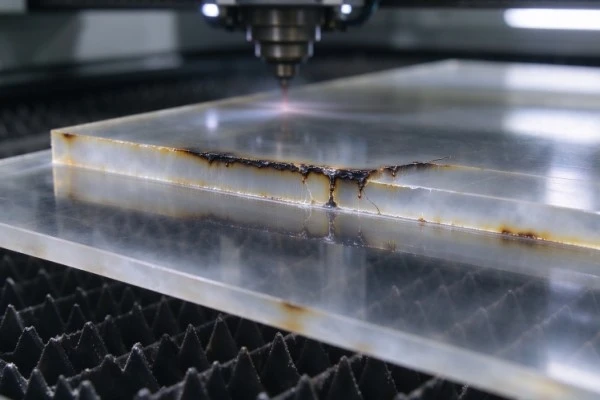
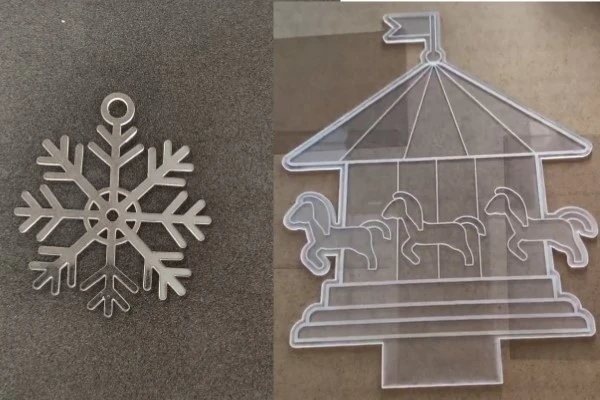
In contrast, acrylic strongly absorbs the 10.6μm wavelength emitted by CO₂ lasers. The absorbed energy rapidly heats the material, causing localized melting and vaporization along the cutting path. With properly optimized laser parameters, CO₂ lasers can produce smooth, transparent edges with a flame-polished appearance, often eliminating the need for additional polishing.
This makes CO₂ lasers particularly suitable for manufacturing advertising signs, decorative products, acrylic letters, crafts, and display models.
For more information about acrylic types and processing parameters, see our guide: Acrylic Laser Cutting: How to Choose the Right Acrylic and Laser Settings.
Actual Performance of Fiber Lasers on Acrylic
Although 1064nm fiber lasers are not suitable for conventional clear acrylic cutting, their performance can vary depending on the acrylic color, pigment composition, and material formulation.
Clear Cast Acrylic
Clear cast acrylic is highly transparent to 1064nm laser light. Most of the laser energy passes through the sheet without being effectively absorbed. Therefore, standard fiber lasers cannot reliably cut through clear acrylic, even when higher laser power is applied.
Black and Dark-Colored Acrylic
Some black or dark-colored acrylic materials contain pigments or additives that absorb near-infrared laser energy. Certain formulations, particularly carbon-black-filled acrylic, may respond to 1064nm fiber lasers and allow surface marking or specialized cutting processes.
However, results vary significantly between materials. Inconsistent absorption can cause localized overheating, melting, rough edges, and thermal damage. Therefore, dark acrylic should not be assumed to be suitable for fiber laser cutting without material testing.
Processing Safety Considerations
Laser processing acrylic generates fumes and airborne particles that require appropriate extraction and filtration. PMMA thermal degradation can release methyl methacrylate and other chemical emissions. A properly designed local exhaust ventilation system should operate throughout processing and continue afterward as required by the equipment and safety procedures.
Suitable Fiber Laser Applications
Although fiber lasers are not the preferred solution for acrylic cutting, they can be used for surface marking and shallow engraving on certain dark acrylic materials with suitable absorption characteristics.
When combined with a digital galvanometer scanning system, a fiber laser can provide fast and precise surface processing. However, it should not replace a CO₂ laser as the primary light source for conventional acrylic cutting.
Regarding cast and extruded acrylic, both can produce high-quality cutting results with CO₂ lasers. Their engraving appearance differs: cast acrylic generally produces a frosted white engraved surface, while extruded acrylic tends to produce a clearer engraved appearance. Material selection should depend on the desired visual effect and final application.
Comparison of Different Laser Sources for Acrylic
Choosing the right laser source is essential for achieving consistent acrylic processing results.
CO₂ Laser (10.6μm)
CO₂ lasers are the preferred choice for acrylic cutting and engraving. Their wavelength is strongly absorbed by PMMA, making them suitable for processing both clear and colored acrylic sheets. With appropriate power and parameter settings, they can produce smooth cutting edges with a transparent, flame-polished appearance.
Typical applications include acrylic sheet cutting, advertising letters, decorative products, crafts, and model making.
1064nm Fiber Laser
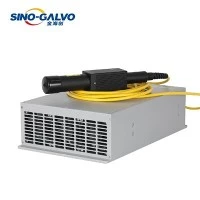
1064nm fiber lasers are primarily designed for metal processing. Since clear acrylic absorbs very little energy at this wavelength, standard fiber lasers cannot reliably cut transparent acrylic.
Some dark acrylic formulations may support surface marking or specialized processing, but the results depend on pigment composition and material properties. Fiber lasers are therefore not recommended as the primary equipment for acrylic cutting.
CO₂ Laser Processing Solution
CO₂ lasers are widely used in industrial acrylic processing for cutting, engraving, and contour processing. Their 10.6μm wavelength is efficiently absorbed by acrylic, making them suitable for processing clear, colored, cast, and extruded acrylic sheets.
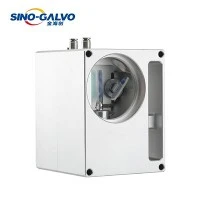
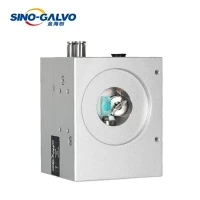
When combined with a galvanometer scanning system, CO₂ lasers can achieve high-speed beam positioning and precise processing of complex patterns. Dynamic focusing technology can further help maintain consistent focus across larger working fields, depending on the optical configuration.
Beyond acrylic, CO₂ laser systems are also commonly used to process other non-metallic materials, including wood, leather, paper, and certain plastics. These capabilities make them suitable for advertising decoration, handicraft manufacturing, signage production, and other industrial applications.
Processing Tips
To achieve consistent results when using a CO₂ laser to cut acrylic, several factors should be considered.
First, laser power, cutting speed, focal position, and auxiliary air pressure should be adjusted according to the acrylic thickness and material type. Thicker sheets generally require higher laser energy or slower processing speeds. Excessive heat input may cause yellowing, melting, or uneven edges.
Second, an appropriate exhaust and filtration system must be installed to remove fumes and airborne particles generated during processing. Ensure that the extraction system operates throughout the cutting process.
Finally, conduct sample tests before mass production. Fine-tuning laser power, scanning speed, focus position, and air pressure helps reduce common defects such as edge burning, excessive melting, and inconsistent cutting quality.
Conclusion
If your goal is to achieve clean cuts and transparent, flame-polished edges when you laser cut acrylic, a CO₂ laser operating at 10.6μm is the preferred solution.
Standard 1064nm fiber lasers are highly effective for metal marking, welding, and cutting, but they are generally unsuitable for cutting clear acrylic due to its low absorption at this wavelength. Although certain dark acrylic formulations can support fiber laser marking or specialized processing, they cannot replace CO₂ lasers for conventional acrylic cutting.
Choosing the right laser wavelength and processing system according to your material and application requirements is essential for achieving high-quality results.