

Properties of Clear PMMA Acrylic Sheets
Clear acrylic sheets (PMMA / plexiglass) boast a light transmittance of over 92%, outstanding impact resistance (16 times stronger than ordinary glass), half the weight of glass, and excellent machinability. Thanks to these superior features, acrylic materials are widely adopted in commercial displays, home decoration, advertising signs, industrial protection components and special engineering projects worldwide.
4 Common Acrylic Cutting Methods & Applicable Conditions


Before choosing CO2 laser for cutting acrylic, you can compare all mainstream cutting solutions:
(1) Manual Scoring & Snapping
Best for straight cuts on thin acrylic sheets ≤5mm thick. Use an acrylic scoring knife paired with a steel ruler to repeatedly score the board to 1/3–1/2 of the sheet thickness, then snap it off quickly along the edge. A utility knife works as a substitute for ultra-thin sheets under 2mm. Only suitable for simple straight-line processing.
(2) Electric Mechanical Saw Cutting
Ideal for medium-thick acrylic over 5mm and curved cutting work. Tools include jigsaws and table circular saws. Use fine-tooth plastic saw blades and feed slowly to prevent acrylic melting and sticking to blades; circular saws need special negative rake angle blades with cooling and dust removal systems. The key is low constant speed to avoid heat buildup and melted edges.
(3) CO2 Laser Precision Cutting (Top Choice: CO2 laser for cutting acrylic)
Most versatile option: fits all acrylic thicknesses generally under 25mm, perfect for complex shapes, hollow-out patterns & intricate engravings. As the premium non-contact processing method, CO2 laser for cutting acrylic delivers burr-free polished cuts with machining accuracy up to ±0.05mm, requiring almost no secondary polishing. Clear transparent acrylic achieves the best cutting finish. Proper ventilation is required to exhaust harmful fumes generated during melting.
(4) Hot Wire Melting Cutting
Only for temporary prototypes and low-precision curved cutting. Heated resistance wire at 200-300℃ melts acrylic, leaving smooth fused edges with obvious heat-affected zones. Not recommended for finished products.
Core Advantages of CO2 Laser for Cutting Acrylic
Using a CO2 laser for cutting acrylic has unparalleled strengths compared with traditional cutting tools:
Mirror-smooth cutting edges, no post-processing needed
CO2 laser melting cutting produces transparent, smooth edges without burrs or serrations. The low surface roughness allows direct bonding, assembly and welding without sanding or flame polishing.
01
Ultra-high precision & stable batch consistency
Positioning accuracy ranges from ±0.01mm to ±0.1mm, contour error controlled within 0.5mm. Mass-produced acrylic parts maintain identical dimensions steadily.
02
Non-contact processing, minimal sheet deformation
The laser beam never physically touches acrylic panels. There is no tool wear, surface indentation or edge collapse; the tiny heat-affected zone greatly reduces warping risks for thin acrylic sheets.
03
High flexibility for custom complex graphics, no molds required
No expensive opening molds are needed. You can adjust cutting patterns via software instantly, processing arbitrary curves, hollow designs and tiny texts efficiently. It perfectly meets personalized custom acrylic fabrication demands.
04
Fast cutting speed & higher material utilization
Cutting speed reaches 3.5m/min for 3mm thick acrylic. The narrow kerf (0.1-0.5mm) cuts down material waste drastically. Automated operation improves overall production efficiency greatly.
05
Application & points
Optimal cutting thickness: under 6-8mm.
Maximum applicable thickness: within 20mm.
Widely used for advertising signage, display stands, art crafts, lamp housings and architectural models.
When acrylic thickness exceeds 8mm, cutting speed drops sharply, and edges tend to turn slightly yellow;
Sheets close to 25mm will have uneven finishes: clean top surface while the bottom suffers from wire drawing defects; thick boards can adopt mechanical sawing alternatively;
Continuous ventilation system is mandatory to discharge odorous smoke during laser processing.
Summary: Choose CO2 Laser for Cutting Acrylic Rather Than Fiber Laser
If you plan to process acrylic sheets professionally, CO2 laser for cutting acrylic is the standard solution. Fiber laser machines are designed mainly for metal cutting; they cannot cut acrylic well and always cause burnt, yellow and charred edges. The final cutting quality of acrylic entirely depends on reasonable parameter settings of your CO2 laser cutter.
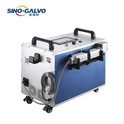
Sino Galvo RF Laser Cutting Machine with RF8330-3D-1200 Dynamic Focusing Scanning System
Sino Galvo 100w CO2 laser cutting machine, equipped with RF laser and 3D dynamic focusing scanning system RF8330-3D-1200, it's a preferred solution for non-metallic material processing. The 10600 nm wavelength is readily absorbed by non-metallic materials including acrylic, wood, leather, fabric, paper and more.It is ideally suited for non-metal-dominated industries such as advertising decoration, garment textiles, packaging die-cutting, and handicraft manufacturing.
The RF8330-3D-1200 galvanometer scanning system, the machine supports a maximum processing area of 1200 mm. Thanks to the stable and high-efficiency galvanometer system, the laser cutting machine can delivers smooth, burr-free cutting edges, boasting irreplaceable advantages over fiber lasers.

FAQ
Q: What laser machine is suitable for cutting clear acrylic?
A: A dedicated CO2 laser cutter is the ideal equipment for acrylic processing. It vaporizes and melts local acrylic material via thermal energy to form neat kerfs. Fiber lasers are not applicable for non-metal acrylic and will lead to burnt yellow edges consistently.
Q: What finish will clear acrylic get after being cut by CO2 laser?
A: With optimized laser parameters, the cut surface stays crystal clear and smooth, ready for direct use without secondary treatment. Improper speed, power or air pressure settings will result in fuzzy, whitened, bumpy or rough edges.
Q: What is the maximum acrylic thickness for CO2 laser cutting?
A: Standard CO2 laser cutters can process acrylic up to 20-25mm thick. The thicker the sheet, the harder it is to guarantee uniform bottom finish. Forced cutting beyond the limit will cause perfect top edges but rough wire-drawn bottom cuts.