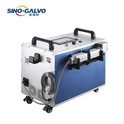


What is laser welding? What are the advantages of laser welding technology? What is the current development status of laser welding technology? In what fields can laser welding technology be applied? This article will take you through these and get closer to the field of laser welding.
What is laser welding? What are the advantages of laser welding technology?
Simply put, laser welding is to heat the surface of the workpiece with laser radiation, and the surface heat diffuses to the interior through thermal conduction. Then, by controlling parameters such as the width, energy, peak power, and repetition frequency of the laser pulse, the workpiece is melted to form a specific molten pool, thereby Implement welding. Its advantages are as follows:
- Laser welding can reduce the amount of heat input to the minimum, the range of metallurgical changes in the heat-affected zone is small, and the deformation caused by heat conduction is also minimal.
- Non-contact welding, the wear and tear of machine tools and deformation can be minimized. The laser beam is easy to focus, align and guide by optical instruments, can be placed at an appropriate distance from the workpiece, and can be redirected between machines, tools or obstacles around the workpiece.
- The laser beam can be focused on a small area, can weld small and closely spaced components, can weld a wide range of materials, and can also join various dissimilar materials to each other.
- It is easy to automate high-speed welding and can also be controlled digitally or by computer. When welding thin materials or fine-diameter wires, there is no trouble such as remelting.
Development status of laser welding technology
Laser welding technology has developed with the development of laser technology. In recent years, new light sources such as blue lasers, green lasers, and femtosecond lasers, and new processes such as swing welding and ARM (adjustable ringmode ) annular adjustable spot welding have continued to develop. was launched to innovatively solve some welding problems in industrial production, which has led to the rapid promotion and development of laser welding in various fields of industrial production.
Metal laser welding technology
The high energy density of laser makes it possible to weld some difficult-to-weld metal materials, but there are still some problems in the welding of gold, silver, copper, aluminum and other highly reflective materials and dissimilar metal materials. The main reasons include:
- High reflectivity and high thermal conductivity, laser welding requires higher starting power;
- During the high-power laser welding process, it is sensitive to changes in the surface state of the material, resulting in poor welding joints/weld seams;
- Laser welding speed is relatively fast, resulting in welding defects such as pores easily appearing inside the weld, especially in aluminum and aluminum alloys.
Efficient laser welding of copper and copper alloys

Copper has excellent electrical and thermal conductivity properties and is widely used in electronic products, electric vehicles and other manufacturing fields. Among them, products such as motors, batteries, sensors, wire harnesses and terminals are the most widely used.
In the past, laser welding of metal materials mainly relied on infrared lasers. However, the thermal conductivity of copper is too high, almost 5 times that of pure iron and 1.7 times that of pure aluminum. Copper has low absorption rate of infrared laser. Simply using infrared laser for linear welding has an unstable process window and maximum penetration fluctuation. , problems such as welding spatter, molten metal splash, pores and large fluctuations in penetration depth are prone to occur.
Therefore, after the emergence of high-power short-wavelength lasers, visible light laser welding and hybrid welding have become ideal processing methods for highly reflective materials such as copper and copper alloys.
- Green light laser welding

Green laser is a kind of visible light with a wavelength of 500~560nm. The absorption rate of copper for green light with wavelength λ = 515nm is as high as 40%, which is about 8 times the infrared light absorption rate of about 1μm, and the energy coupling efficiency is higher. Sensitivity to the degree of oxidation is also reduced.
The use of green laser can significantly reduce the threshold power of copper deep penetration welding, the amount of melt spray and spatter on the weld surface is small, and it is almost unaffected by the welding speed. If the beam scanning, beam defocus and correct laser power modulation are increased, the welding quality can be significantly improved. While the number of weld defects is greatly reduced, the weld surface will be more regular and uniform.
- Blue light laser welding

The shorter the wavelength, the higher the photon energy, which helps to increase the material's absorption rate of laser light. The wavelength of blue laser is 400nm ~ 500n. The semiconductor laser based on gallium nitride material can directly generate laser with a wavelength of 450 nm without further frequency doubling. It has the advantages of simple structure, easy use, electro-optical conversion efficiency and high absorption rate.
Compared with fiber lasers commonly used in industrial processing, blue light lasers have a 10-60% increase in the absorption rate of metal materials at 450nm, especially the increase in the absorption rate of highly reflective metal materials such as copper and gold. It has been verified that the energy consumption required for copper welding is 84% lower than that of infrared lasers, which means that when an infrared laser requires 10 W of laser power to weld copper materials, using a blue laser only requires about 1 kW or 0.5 kW of power.
- Double beam hybrid welding
Using the infrared -visible light double-beam composite welding process, using a smaller power visible light laser, the infrared laser can achieve forced deep-penetration welding of copper when the power is lower than the deep-penetration welding threshold power, and significantly reduce welding spatter, and the equipment cost is low. The welding quality is high and is considered to have very outstanding advantages and good application prospects.
- Aluminum alloy laser swing welding
Laser swing welding means that during the welding process, the beam simultaneously swings in various shapes such as circular, and spiral while moving along the direction of the weld.
Porosity is a common defect when welding aluminum alloys with conventional single-focus focused laser beams. The main reasons for the formation of pores in aluminum alloys are:
①the welding pool and keyhole can easily collapse and cause pores;
②The solubility of hydrogen in aluminum alloys will decrease sharply as the temperature decreases, resulting in the precipitation of supersaturated hydrogen during the solidification process and the formation of hydrogen pores. The presence of pores can cause stress concentration in the weld, which can lead to cracking of the weld during solidification.
Achieved through galvanometers that can withstand high-power lasers . The beam action area of laser swing welding increases, which increases the area of the keyhole and molten pool and the size of the root of the molten pool, improving the stability of the keyhole and molten pool. Stability, it can significantly improve defects such as poor fusion and undercut . At the same time, the stirring of the molten pool by the swinging beam accelerates the convection of the molten pool, which increases the escape speed of bubbles in the molten pool and reduces the porosity.
Application fields of laser welding technology
Laser was used for welding no later than cutting. At present, there are already companies specializing in laser welding in our country. In the early days, lamp-pumped laser and YAG laser welding were the main ones. They are all very traditional low-power laser welding. They are used in molds, advertising letters, and glasses. It has been used in several fields such as jewelry and jewelry, but the scale is very limited. In recent years, with the continuous improvement of laser power, more importantly, semiconductor lasers and fiber lasers have gradually developed laser welding application scenarios, breaking the original technical bottleneck of laser welding and opening up new market space.
Application of laser welding technology in automobile manufacturing
Laser was used for welding no later than cutting. At present, there are already companies specializing in laser welding in our country. In the early days, lamp-pumped laser and YAG laser welding were the main ones. They are all very traditional low-power laser welding. They are used in molds, advertising letters, and glasses. It has been used in several fields such as jewelry and jewelry, but the scale is very limited. In recent years, with the continuous improvement of laser power, more importantly, semiconductor lasers and fiber lasers have gradually developed laser welding application scenarios, breaking the original technical bottleneck of laser welding and opening up new market space.
What is the development trend of laser welding technology?
With the further development and breakthrough of welding technology, the uniqueness of laser welding technology has been shown in the research and development process. Laser welding technology can weld metal materials quickly and efficiently. When the laser beam is generated, due to its high focusing characteristics, the laser beam contains extremely high power density, which allows the laser beam to A large amount of thermal energy is released in an extremely short time, thereby greatly improving the welding efficiency and ensuring the welding quality.
In addition, due to the instantaneous welding advantages of laser welding technology, it has a very wide range of application prospects. In the actual application process of laser welding technology, when the laser beam directly irradiates the surface of the metal material, it will not affect the metal material outside the irradiation area, so it will not cause major damage to the surface of the metal material during the welding process. And after the welding process is completed, there is no need to perform related surface processing. This makes laser welding technology particularly suitable for processing the surfaces of various precision parts, so that more difficult welding operations can be quickly realized.
In addition, in the previous welding technical specifications, it was usually stipulated that the material requirements for all welding materials must be consistent. With laser welding technology, there is no need to have great restrictions on the material of welding materials, so even if the materials are different Welding materials can also be easily welded using laser welding technology. It can be said that the formation and widespread application of laser welding technology not only effectively overcomes the problems that arise in traditional welding technology, but also reduces the difficulty of traditional welding operations.
After more than half a century of development, laser welding technology has become increasingly sophisticated and has been gradually used in more and more industrial fields.
In the application fields of aerospace, electronic instrumentation, machinery manufacturing, steel metallurgy, automobile manufacturing, medical equipment and other industries, laser welding technology plays an increasingly important role. For example, in the production of automobile parts, laser welding technology can be used to The covering parts of vehicles are processed and produced, and advanced countries such as the United States and Japan also apply laser welding technology to the production of aviation parts in a pure nitrogen environment.
With the advancement of laser welding technology, more and more high-power, large-capacity laser generators and intelligent laser welding control technologies will be developed. At the same time, the welding process will also become more refined, which will make laser welding technology more sophisticated. It has extremely bright application prospects in future development.