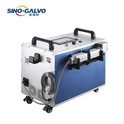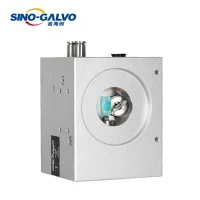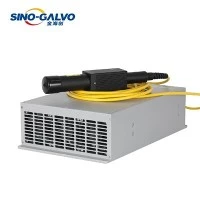


In industrial production, laser is one of the more popular marking technologies. Metals, plastics, ceramics, and other materials can be marked with laser radiation at wavelengths of 1064 nm (infrared), 532nm (green), and 355nm (ultraviolet). As a tool, lasers can be applied to digital, text, trademark, or machine-readable codes, such as data matrix codes that have high information density and are arranged in tight spaces on different scales.

Precision marking
For the marking of plastics, Q-switched short-pulse solid-state lasers or fiber lasers are commonly used. These lasers typically have an average power of less than 100W and pulse durations between 10 and 100ns. The pulse frequency is up to 120kHz, and in the case of a fiber laser, even up to 1MHz. In this way, the interaction with the material to be identified can be fine-tuned. The short pulse time results in a high pulse peak power of tens of kilowatts reaching an average of 10W.
The laser is a diode pumped laser with high energy efficiency. They have good focusing ability and are therefore very suitable for fine marking. The diode-pumped solid-state laser has a very high beam quality, which enables the laser beam to obtain a small focus diameter during the marking process. In this way, precise track widths as small as 30 m can be achieved on small parts.

Adaptation of absorption characteristics
Lasers used for marking typically produce radiation in the infrared wavelength range. Green lasers and ultraviolet lasers target plastics and semiconductor materials. The use of UV wavelengths in special marking applications opens up new possibilities for laser marking on plastics. Short-wavelength directly reacts with plastic compounds without heating, so there is no damage to the materials; especially some more discerning materials, plastics containing flame retardants, or sensitive electronic components. These lasers perform high contrast marking at very high speeds without any negative impact on surface quality.
Leather laser marking machine is a kind of carbon dioxide laser marking machine for marking on fabric or leather. Cloth leather is already indispensable for clothing and shoes in life. It is closely related to people's lives. Do you know how to get the exquisite patterns on leather shoes, belts and watch straps?
People's common clothes, leather shoes, belts, and watch straps have very delicate patterns, some of which are printed. With the development of technology, the birth of leather laser marking machines has replaced traditional methods. Leather laser marking machines can A variety of patterns are marked on the fabric and leather, such as text, logos, trademarks, dates, etc., and the equipment features fine marking, stable performance, and maintenance-free. Carbon dioxide laser marking machine can not only mark on cloth leather but also widely used in other non-metal industries.