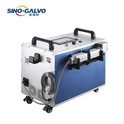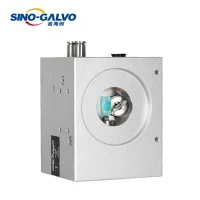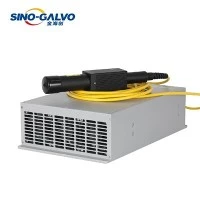


Laser marking technology is one of the largest application areas of laser processing. Laser marking is a marking method that uses a high-energy density laser to locally irradiate the workpiece to vaporize the surface material or cause a chemical reaction to change color, thereby leaving a permanent mark. Laser marking can produce a variety of characters, symbols and patterns, etc., and the size of the characters can range from millimeters to micrometers, which has special significance for product anti-counterfeiting.

Principle of laser coding
The basic principle of laser marking is that a high-energy continuous laser beam is generated by a laser generator, and the focused laser acts on the printing material to instantly melt or even vaporize the surface material. By controlling the path of the laser on the surface of the material, it forms The required graphic marks.
Feature one
Non-contact processing, can be marked on any special-shaped surface, the workpiece will not deform and generate internal stress, suitable for marking metal, plastic, glass, ceramic, wood, leather and other materials.
Feature two
Almost all parts (such as pistons, piston rings, valves, valve seats, hardware tools, sanitary ware, electronic components, etc.) can be marked, and the marks are wear-resistant, the production process is easy to realize automation, and the marked parts have little deformation.
Feature three
The scanning method is used for marking, that is, the laser beam is incident on two mirrors, and the computer-controlled scanning motor drives the mirrors to rotate along the X and Y axes respectively. After the laser beam is focused, it falls on the marked workpiece, thus forming a laser marking trace.
Advantages of laser coding

The extremely thin laser beam after laser focusing is like a tool, which can remove the surface material of the object point by point. Its advanced nature is that the marking process is non-contact processing, which does not produce mechanical extrusion or mechanical stress, so it will not damage the processed article; Due to the small size of the laser after focusing, the small heat-affected area, and fine processing, some processes that cannot be achieved by conventional methods can be completed.
The "tool" used in laser processing is the focused light spot, no additional equipment and materials are needed. As long as the laser can work normally, it can be processed continuously for a long time. The laser processing speed is fast and the cost is low. Laser processing is automatically controlled by a computer, and no human intervention is required during production.
What kind of information the laser can mark is only related to the content designed in the computer. As long as the artwork marking system designed in the computer can recognize it, the marking machine can accurately restore the design information on a suitable carrier. Therefore, the function of the software actually determines the function of the system to a large extent.

In laser applications in the SMT field, laser marking traceability is mainly performed on the PCB, and the destructive effects of lasers of different wavelengths on the PCB tin masking layer are inconsistent.
At present, the lasers used in laser coding include fiber lasers, ultraviolet lasers, green lasers and CO2 lasers. The commonly used lasers in the industry are UV lasers and CO2 lasers. Fiber lasers and green lasers are relatively less used.
Fiber laser
Fiber pulse laser refers to a kind of laser produced by using glass fiber doped with rare earth elements (such as ytterbium) as the gain medium. It has a very rich luminous energy level. The wavelength of pulsed fiber laser is 1064nm (the same as YAG, but the difference is YAG's working material is neodymium) (the typical wavelength of QCW, continuous fiber laser is 1060-1080nm, although QCW is also a pulsed laser, but its pulse generation mechanism is completely different, the wavelength is also different), is a near-infrared laser. It can be used to mark metal and non-metal materials because of the high absorption rate.

The process is achieved by using the thermal effect of laser on the material, or by heating and vaporizing the surface material to expose deep layers of different colored materials, or by heating the microscopic physical changes on the surface of the material (such as some nanometers, ten nanometers) Grade micro-holes will produce a black body effect. Very little light can be reflected, making the material appear dark black) and its reflective performance will change significantly, or through certain chemical reactions that occur when heated by light energy, the desired Graphics, characters, QR codes and other information.
UV laser
Ultraviolet laser is a kind of short-wavelength laser. Generally, frequency doubling technology is used to convert the infrared light (1064nm) emitted by the solid laser into 355nm (triple frequency) and 266nm (quadruple frequency) ultraviolet light. The photon energy is very large, which can match the energy levels of some chemical bonds (ionic bonds, covalent bonds, metal bonds) of almost all substances in nature, and directly break the chemical bonds, causing the material to undergo photochemical reactions without obvious thermal effects (nucleus, Certain energy levels of the inner electrons can absorb ultraviolet photons, and then transfer the energy through the lattice vibration, resulting in a thermal effect, but it is not obvious), which belongs to "cold working". Because there is no obvious thermal effect, UV laser can not be used for welding, generally used for marking and precision cutting.

The UV marking process is realized by using the photochemical reaction between UV light and the material to cause the color to change. The use of appropriate parameters can avoid the obvious removal effect on the surface of the material, and thus can mark graphics and characters without obvious touch.
Although UV lasers can mark both metals and non-metals, due to cost factors, fiber lasers are generally used to mark metal materials, while UV lasers are used to mark products that require high surface quality and are difficult to achieve with CO2, forming a high-low match with CO2.
CO2 laser
CO2 is a commonly used gas laser with abundant luminous energy levels. The typical laser wavelength is 9.3 and 10.6um. It is a far-infrared laser with a continuous output power of up to tens of kilowatts. Usually a low-power CO2 laser is used to complete the high Marking process for non-metallic materials such as molecules. Generally, CO2 lasers are rarely used to mark metals because the absorption rate of metals is very low (high-power CO2 can be used to cut and weld metals. Due to the absorption rate, electro-optical conversion rate, optical path and maintenance and other factors, it has been gradually used by fiber lasers. replace).

The CO2 marking process is realized by using the thermal effect of the laser on the material, or by heating and gasifying the surface material to expose the deep layer of different colored materials, or by light energy heating the microscopic physical changes on the surface of the material to make it reflective Significant changes occur, or certain chemical reactions that occur when heated by light energy, and the required graphics, characters, two-dimensional codes and other information are displayed.CO2 lasers are generally used in electronic components, instrumentation, clothing, leather, bags, shoes, buttons, glasses, medicine, food, beverages, cosmetics, packaging, electrical equipment and other fields that use polymer materials.
Summary
Fiber lasers and CO2 lasers both use the thermal effect of the laser on the material to achieve the marking effect, basically destroying the surface layer of the material to form a rejection effect, leaking the background color, and forming chromatic aberration; while the ultraviolet laser and the green laser use the laser to The chemical reaction of the material causes the color of the material to change, and then does not produce the rejection effect, forming graphics and characters without obvious touch.
Sino-Galvo Tech. is the leading galvanometer scanner manufacturer. The laser welding machine equiped with our scanner system can reach the heighest precision leavel. Welcome to contact us for further information.
Welcome to consult: +86-18921551023