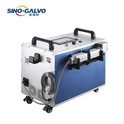


The previous mentioned the core characteristics of laser plastic marking technology. For details, please click: Complete Technical Guide To Laser Marking On Plastic Parts Ⅰ. Now, from the perspective of industrial applications, we will analyze the advantages of laser plastic marking.
Laser Marking Machine for Plastic vs Inkjet & Sticker Labeling
A laser marking machine for plastic offers superior cost efficiency, faster speed and better sustainability compared with traditional inkjet printing and adhesive labeling. Traditional methods rely on continuous consumables such as ink, solvent and labels, resulting in high long-term material and maintenance costs.
In contrast, plastic laser marking requires no consumables, features a long machine lifespan and only simple daily maintenance, greatly reducing overall production costs for mass production.
In terms of efficiency, labeling causes bubbles, wrinkles and high rework rates, while inkjet needs frequent cleaning, curing and debugging. A laser marking machine for plastic supports fully automatic digital marking, completing each part within 0.1–1 second. Its stable, high-speed output is 3–5 times faster than traditional processes and perfectly fits modern automated assembly lines.
Environmentally, ink and labels produce solid waste and VOC pollution. Laser plastic marking adopts pure physical processing with zero chemical emissions and zero consumable waste. The permanent, fade-proof marks support product traceability and recycling, fully meeting green manufacturing and carbon-neutral industrial standards.
Common Laser Marking Types for Plastic and Applications
Laser marking machine for plastic supports multiple processing types to meet functional and decorative marking demands for various plastic parts.


Plastic black marking: The most common process for ABS, PC, PVC and general engineering plastics. Controlled laser carbonization creates high-contrast, wear-resistant black marks for serial numbers, QR codes, model information and traceability coding.
Plastic white marking: Forms uniform matte white patterns through laser micro-foaming without carbonization. Ideal for dark and black plastic parts widely used in automotive interiors and high-end electronic plastic housings.
Transparent plastic marking: Adopts cold processing for PET, PC and acrylic. The laser marking machine for plastic precisely controls laser energy to avoid whitening, cracking or piercing, delivering clear and traceless fine marking on transparent packaging and optical components.
Paint stripping marking: Accurately removes surface paint layers without damaging plastic substrates, creating two-tone logos and decorative textures for colored sprayed plastic casings.
Surface ablation marking: Removes surface films and thin plastic layers to form 3D embossed effects, improving texture for composite and film-covered plastic parts.
Color marking: Matches special color additives to produce stable red, blue and yellow laser colors without ink, suitable for high-end customized plastic appearance processing.
Plastic laser welding: Extends laser processing functions to achieve seamless welding for medical and waterproof plastic components with high tightness and no auxiliary materials.
Standardized Operating Procedures for Plastic Laser Marking
Stable high-yield production with a laser marking machine for plastic requires standardized process control covering pre-production, inline production and daily maintenance.
Parameter optimization: Adjust laser power, scanning speed, focal length and pulse parameters according to plastic material, thickness and marking type. Optimize and fix parameters in advance to avoid faint marks, burning or thermal deformation during batch processing.
Surface pre-treatment: Remove oil, dust, fingerprints and release agent residues to ensure uniform laser absorption. Calibrate fixtures for irregular workpieces to guarantee accurate marking positioning.
Ventilation and purification: Equip exhaust and dust removal systems to eliminate micro-powder and volatile odor generated during plastic laser etching, ensuring workshop safety and clean marking results.
Full-process quality control: Implement first-piece confirmation, regular inline inspection and final double inspection to monitor contrast, clarity, color consistency and positioning accuracy, ensuring stable batch quality.
Regular equipment maintenance: Perform daily lens cleaning, weekly calibration and monthly power testing. Scheduled optical maintenance reduces errors, defects and unexpected downtime.
Plastic-glass composite processing: Set independent protection parameters for glass areas to avoid whitening and cracking while ensuring clear marking on plastic sections.
Technical iteration upgrading: Update process parameters for new modified plastics and ultra-thin materials. Combine AI positioning and automatic lines to realize intelligent and high-efficiency plastic laser marking production.
Frequently Asked Questions
Can clear transparent plastic get high-definition laser marking?
+
-
High-definition laser marking on plastic is fully achievable for clear transparent plastics such as PET and acrylic. Relying on professional UV cold processing technology and matched laser absorbers, the laser accurately acts on the plastic surface without penetrating or damaging the transparent substrate. It avoids whitening, blurring, and cracking problems, delivering ultra-fine, clear, and invisible-bottom markings that maintain the original light transmittance and appearance of transparent plastic parts.
Is laser marking on plastic parts cheaper than inkjet printing and sticker labeling in mass production?
+
-
Laser marking on plastic parts features prominent cost advantages in long-term mass production. Unlike inkjet printing and sticker labeling that require continuous consumption of ink, labels, and adhesives, laser marking is a completely consumable-free process. Though with slight initial equipment investment, it saves massive recurring material and maintenance costs. With higher efficiency and lower rework rates, it effectively reduces overall production expenses for plastic part identification.
Will laser markings on plastic fall off or fade after long-term use?
+
-
Markings generated by laser marking on plastic are permanent and highly durable. Different from surface-attached ink and labels, laser marks are formed through surface micro-ablation and molecular modification, embedding into the plastic's surface layer. They possess excellent resistance to friction, scraping, high and low temperatures, and aging. Under normal use and outdoor environments, the markings will not fall off, fade, or blur, ensuring lifelong stable identification of plastic products.
What parameters need to be optimized for high-quality laser marking on plastic?
+
-
High-quality laser marking on plastic parts relies on optimized core laser parameters, including laser power, scanning speed, focal length, pulse frequency, and pulse width. Different plastic materials and marking types (black marking, white marking, ablation) require targeted parameter calibration. Reasonable parameter matching prevents burning, blurring, and thermal deformation. Regular parameter calibration ensures consistent marking clarity, contrast, and batch stability for industrial mass production.