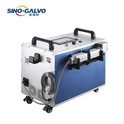


For a long time, laser technology has been widely known for its use in welding, cutting, and marking. In recent years, with the gradual popularization of laser cleaning, the concept of laser surface treatment has become a focus of attention and appeared in people's minds. Laser processing is carried out in a non-contact method, with high flexibility, high speed, no noise, small heat affected zone, non-destructive substrate, no consumables, and environmentally friendly .
Laser surface treatment has many application categories besides laser cleaning, such as laser polishing, laser cladding, laser quenching, and so on. These methods are used to alter specific physical and chemical properties of material surfaces, such as processing the surface into hydrophobic functionality, or generating small depressions with a diameter of about 10 microns and a depth of only a few microns using laser pulses to increase roughness, enhance surface adhesion, and so on.
1. Laser Quenching
Laser quenching is one of the solutions for processing high stress complex components, which can subject parts with high wear such as camshafts and bending tools to higher stress and extend their lifespan.
The principle of laser quenching
Laser quenching is a quenching technology that uses laser to heat the surface of a material above the phase transition point. As the material cools down, austenite transforms into martensite, thereby hardening the surface of the material.

The advantages of laser quenching
1. High precision hardened layers with excellent quality can be obtained. The hardness is increased by 15% -20% compared to conventional quenching. After quenching, the wear resistance of cast iron can be improved by 3-4 times, and the quenching depth can be precisely controlled.
2. Only local and thin surface heating is applied to critical parts of the work, resulting in less heat input to the workpiece and good energy-saving effect.
3. Heat treatment has minimal deformation and no mechanical deformation, making it suitable for high-precision part processing and serving as the final processing step for materials and parts. This is because the laser power density is high, and the interaction time with a certain point on the part is very short, so the thermal deformation zone and overall change of the part are small. For long and thin-walled workpieces, this advantage is particularly prominent.
4. Due to the non-contact heating and self cooling quenching of the workpiece irradiated by the beam, this technology is a clean heat treatment.
5. Good processing flexibility and wide applicability. A flexible light guiding system can be used to guide the laser to the processing area at will, making it easy to process difficult to machine areas such as deep holes, inner holes, blind holes, and grooves, as well as local areas with very small spaces.
6. There is no obvious mechanical force or tool wear, low noise, low pollution, pollution-free treatment method, and good working conditions.
7. The process cycle is short, the production efficiency is high, and the cost is low. The entire process can be controlled by a computer, with a high degree of automation. It can be incorporated into the production line and is easy to mass produce.
2. Laser texturing
The principle of Laser texturing
The laser roughening system for rolling mill mainly includes the generation and transmission of pulsed laser, machine tool and control system, auxiliary side blowing and cooling system. Through pulsed laser, a series of pits and protrusions are formed on the surface of the rolling mill, and the size and distribution of the pits and protrusions directly affect the roughening effect
Hydrophobic surface structures can allow water to flow off the surface. This characteristic can be achieved by creating sub micron structures on the surface using ultra short pulse lasers, and precise control of the desired structure can be achieved by changing the laser parameters.

The advantages of laser texturing
1. Has high wear resistance,
2. Can form different surface morphologies of fuzz points according to process requirements, Repeatable process flow
3. Excellent formability and coating performance
3 .Laser Colorful Surface Finish
Laser tempering is commonly used in laser colorful surface finish, also known as laser color marking. The process principle is that when laser heating materials, the metal is locally heated to slightly lower than its melting point. Under appropriate process parameters, the structure of the gate will change at this time; An oxide layer will form on the surface of the workpiece, and under the irradiation of light, various tempering colors will appear due to the interference of incident light. The iridescent marking layer generated on the surface will change with different observation angles, and the marked pattern will also change into various colors.

4. Laser Cladding
The principle of Laser Cladding
Laser cladding technology uses high-energy laser beam irradiation to rapidly melt, expand, and solidify a layer of material with special physical, chemical, or mechanical properties on the surface of the substrate, forming a new material different from the substrate to compensate for the lack of high performance in the substrate. According to the performance requirements of the workpiece, various components of alloys, metal based composite materials, etc. can be melted to prepare surface coatings with characteristics such as heat resistance, corrosion resistance, wear resistance, friction reduction, oxidation resistance, and non-magnetic properties, so that the material has a structure and properties that conventional processing does not possess.
It is an additive manufacturing process suitable for mixed materials of metals and metal ceramics. This allows for the creation or modification of 3D geometric shapes. Using this production method, laser can also be used for repair or coating. Therefore, in the aerospace field, additive manufacturing is used to repair turbine blades. In the field of tool and mold manufacturing, it is possible to repair broken or worn edges and shaping functional surfaces, or even locally install armor. To prevent wear and corrosion, coatings are applied to bearing positions, rollers, or hydraulic components in the fields of energy technology or petrochemicals. Moreover, additive manufacturing is also used in the field of automobile manufacturing. We will make improvements to a large number of components here. In conventional laser metal cladding, the laser beam first locally heats the workpiece and then forms a molten pool. Then, fine metal powder is directly sprayed into the molten pool from the nozzle of the laser processing head.

The advantages of Laser Cladding
Compared with many traditional surface treatment technologies, laser cladding technology has the following significant advantages and characteristics:
(1) Laser cladding can produce a small heat affected zone on the matrix, and the workpiece deformation is small.
(2) Metallurgical bonding can be achieved between the cladding layer and the base material, and the dilution rate of the cladding material is low.
(3) The cladding layer has small grain size and dense structure, and can obtain high hardness, wear resistance and corrosion resistance.
(4) Can achieve selective local fine repair, effectively reduce the cost of repair.
(5) The powder material system has a high adaptability, and most conventional and special metal powder materials can be fused to the surface of metal parts.
5. Laser Shock Peening
The principle of Laser Shock Peening
Laser shock strengthening, also known as laser shock peening, is to irradiate the surface of metal parts with high energy density, high focus, short pulse laser (λ=1053nm), and the surface metal (or absorption layer) instantly forms a plasma explosion under the action of the high power density laser, and the explosion shock wave is transmitted to the inside of the metal parts under the constraint layer, so that the surface grain produces compressive plastic deformation. Surface strengthening effects such as residual compressive stress and grain refinement are obtained in the thicker surface of parts.
The advantages of Laser Shock Peening
Compared with the traditional mechanical shot blasting has the following advantages:
1. Strong orientation: the laser acts on the metal surface at a controllable Angle, and the energy conversion efficiency is high, while the mechanical projectile impact Angle is random;
2. Large force: the instantaneous pressure generated by laser shot blasting plasma is as high as several GPa; High power density: laser shock peak power density reaches several to dozens of GW/cm2;
3. Good surface integrity: laser shock has almost no sputtering effect on the surface, and after mechanical shock peening, the surface topography is damaged and stress concentration is generated. The maximum compressive stress value after laser shock is better, the surface residual compressive stress is increased by about 40% to 50%, and the fatigue life of the workpiece, high temperature resistance and bending forming and other related indicators are significantly improved.

At present, it has been used in aircraft surface treatment, aircraft engine surface treatment and other fields.