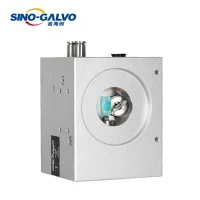


F-theta scan lens play a pivotal role in enhancing laser scanning and accuracy, revolutionizing various industries from medical to manufacturing. These specialized optical components, also known as focus lens or field lens, are integral to laser marking machines and other precision laser applications. By intelligently manipulating the laser beam's focus across a flat field, f-theta lens significantly improve scanning speed, maintain consistent spot size, and minimize distortion. This results in higher precision, increased productivity, and expanded capabilities in laser-based processes.

1. Understanding F-Theta Scan Lens: Key Components and Principles
F-theta scan lens are sophisticated optical devices designed to focus laser beams onto a flat surface with high precision. These lens are essential in laser scanning systems, where they work in conjunction with galvanometer scanners to direct and focus laser beams accurately.
Principles of Operation
The fundamental principle behind f-theta lens is their ability to maintain a linear relationship between the scan angle and the position of the focused spot on the work surface. This linearity is crucial for achieving uniform spot size and energy distribution across the entire scan field. Unlike conventional lenses, which produce a curved focal plane, f-theta lens create a flat focal plane, enabling precise focusing on planar surfaces.
Key Performance Metrics
Several metrics are used to evaluate the performance of f-theta scan lens
Scan Field
This refers to the area over which the lens can effectively focus the laser beam. A larger scan field is generally desirable, but it must be balanced against other factors such as spot size and accuracy.
01
Focal Length
This is the distance from the lens to the focal point. It affects working distance, spot size, and overall system design.
02
Spot Size
The diameter of the focused laser beam, which is crucial for determining resolution and energy density.
03
Telecentricity
The degree to which the chief rays are parallel to the optical axis, affecting the consistency of spot size across the scan field.
04
Wavelength Compatibility
F-theta lenses are designed for specific laser wavelengths, and choosing the correct lens for the laser source is essential.
05
2. Enhancing Laser Scanning Precision with F-Theta Lens
F-theta scan lens significantly improve laser scanning precision through several mechanisms, each contributing to the overall enhancement of system performance.
Consistent Spot Size Across the Scan Field
One of the primary advantages of f-theta lens is their ability to maintain a consistent spot size across the entire scan field. This uniformity is crucial for applications requiring precise energy delivery, such as laser marking or micromachining. By minimizing variations in spot size, f-theta lens ensure that the laser's energy density remains constant, resulting in uniform processing quality regardless of the beam's position within the scan field.
Minimizing Distortion and Aberrations
F-theta lenses are designed to minimize optical distortions and aberrations that can affect laser beam quality. These include:
Spherical Aberration
F-theta lens correct for spherical aberration, ensuring that light rays from different parts of the lens converge at the same focal point.
Field Curvature
By creating a flat focal plane, f-theta lens eliminate the curvature that would otherwise occur with conventional lens.
Astigmatism
Advanced f-theta lens designs incorporate astigmatism correction, maintaining beam circularity across the scan field.
Enhancing Scanning Speed and Efficiency
The design of f-theta lens allows for rapid beam positioning without compromising accuracy. This capability enables high-speed scanning applications, significantly increasing throughput in industrial processes. The lens's ability to maintain focus across a flat field means that the scanning system doesn't need to compensate for focal plane changes, allowing for faster and more efficient operation.
3. Applications & Advancements in F-Theta Scan Lens Technology
F-theta scan lens have found applications across a wide range of industries, driving innovation and enabling new capabilities in laser-based technologies.
Industrial Applications

Laser Marking
For high-speed, high-precision marking on various materials.

Laser Cutting
Enabling precise cuts in materials ranging from metals to plastics.

Additive Manufacturing
Supporting the accuracy required in 3D printing and laser sintering processes.

Laser Welding
Providing the focused energy needed for precise welding applications.
Medical and Scientific Applications


Emerging Technologies and Future Trends
The field of f-theta lens technology continues to evolve, with several exciting developments on the horizon:
Multi-wavelength F-theta Lens
Designed to work with multiple laser wavelengths, increasing versatility.
Large Format F-theta Lens
Expanding scan fields for larger-scale applications.
Integration with Adaptive Optics
Combining f-theta lens with adaptive optical systems for even greater precision and flexibility.
Materials Innovation
Development of new optical materials to enhance lens performance and durability.
As laser technologies continue to advance, f-theta scan lens will undoubtedly play an increasingly important role in pushing the boundaries of what's possible in precision laser applications.
Conclusion
F-theta scan lens have revolutionized laser scanning technology, offering unparalleled precision, speed, and versatility across a wide range of applications. From industrial manufacturing to cutting-edge medical procedures, these specialized optical components continue to drive innovation and enable new possibilities in laser-based processes. As technology advances, we can expect to see even more sophisticated f-theta lens designs, further enhancing the capabilities of laser systems and opening up new frontiers in precision manufacturing, scientific research, and medical treatments.
For more information about optical scanning mirrors and other advanced laser scanning technologies, please don't hesitate to contact us at Info@sino-galvo.com. Our team of experts is ready to assist you in finding the perfect solution for your laser scanning needs.