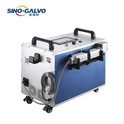


Laser welding refers to the process of using high-energy laser beams to melt and solidify metals or alloys to form welds. In practical operation, by adjusting the duty cycle and pulse frequency of the laser welding machine, welding quality indicators such as penetration depth, weld morphology, and strength can be affected.
So, what are the duty cycle and pulse frequency of laser welding? The following text will provide you with detailed answers.
1, What is the duty cycle of laser welding?
The duty cycle refers to the ratio of the laser beam action time to the period, in percentage units. The higher the duty cycle, the longer the laser beam is irradiated, and the longer the duration of each pulse, thereby increasing the time and depth of metal heating.

Briefly, the duty cycle refers to the proportion of laser beam emission time to welding time. Taking 1 second as an example, if the duty cycle is set to 100%, during the laser welding process, the laser will emit light for 1 second , which is equivalent to emitting light for the entire period of welding time. If the duty cycle is set to 90%, it means that welding takes 1 second, and the output time of the laser beam takes 0.9 seconds, while the non output time takes 0.1 seconds.
Similarly, it can be inferred that:
20% Duty Cycle: Suitable for light-duty and occasional welding tasks. The output time of the laser beam takes 0.2 seconds, while the non output time takes 0.8 seconds.
40% Duty Cycle: Suitable for general-purpose welding. The output time of the laser beam takes 0.4 seconds, while the non output time takes 0.6 seconds.
60% Duty Cycle: Ideal for medium-duty welding applications. The output time of the laser beam takes 0.6 seconds, while the non output time takes 0.4 seconds.
In other words, the higher the duty cycle, the longer the laser beam irradiation time, and the longer the action time of each pulse, thereby increasing the time and depth of metal heating.
So, how is the output time of the laser beam distributed? Taking 90% duty cycle as an example, with a welding time of 1 second, how is the 0.9 second light output time distributed? Is it front light or rear light? Or is it a light coming out in the middle? So we need to refer to another data - PULSE FREQUENCY.
2. What is the pulse frequency of laser welding?
The pulse frequency of a laser welding machine refers to the number of times the pulse is repeated per unit time, usually measured in Hertz (Hz) or Kilohertz (kHz). The higher the frequency, the shorter the pulse time, and the shorter the heating time of the metal. However, as the laser energy density increases, the welding speed will also correspondingly increase.

To be brief, pulse frequency refers to the number of times a laser pulse cycle occurs within one second, with the laser beam emitting and not emitting as a pulse cycle. For example, setting the pulse frequency to 2000Hz means that within 1 second, the number of cycles between the laser emitting and non emitting pulses reaches 2000 times.
3. The influence of duty cycle and pulse frequency on welding quality
(1) The influence of duty cycle on welding quality
The variation of duty cycle will have an impact on the penetration depth, weld width, and morphology.
*When the duty cycle is small, although the width of the weld seam is narrow, the depth of the weld seam is shallow, the frictional heat generation is not enough, and the stress strength of the weld seam is relatively low.

*As the duty cycle gradually increases, the width of the weld seam increases, the depth of the weld seam increases, and the strength also increases accordingly.

*But if the duty cycle is too large, it is easy to cause an increase in the area affected by excessive heat, the generation of thermal cracks, and seriously affect the welding quality.

(2)The influence of pulse frequency on welding quality
The higher the frequency, the shorter the pulse width, and the corresponding reduction in the action time of the laser beam, which will increase the welding speed. However, if the frequency is too high, the time for controlling the liquid metal in the molten pool will also become very short, and the welding quality will be affected.
In addition, the energy intensity of the laser beam increases at high frequencies. If the focal spot diameter remains unchanged, the energy density also increases, which may damage materials with poor heat dissipation performance.
For more articles on laser welding seam issues, please click on: 9 Common Issues & Solutions In Laser Welding
4. Optimization measures
In order to improve the welding quality of laser welding, it is necessary to choose appropriate duty cycle and frequency according to different welding requirements in practical operation. Generally speaking, when a large penetration depth and slow welding speed are required, it is advisable to choose a lower frequency and a longer duty cycle; When fast welding speed is required, it is advisable to choose a higher frequency and a shorter duty cycle. In addition, in order to prevent internal defects in the weld and ensure welding quality, appropriate preheating and post heating measures can also be taken during the laser welding process.
For example, when welding thin plates (0.5 or 0.6 millimeters thick), if the duty cycle is set to 100%, the substrate is prone to breakdown. If the duty cycle is adjusted to 70% or 80%, the thin plate can be maximally protected from breakdown.
【 Conclusion 】
Laser welding technology is widely used in industrial production. Controlling the duty cycle and frequency of laser can affect welding quality. In order to improve the quality and efficiency of laser welding, it is necessary to choose the duty cycle and frequency reasonably according to different welding requirements, and take corresponding optimization measures.