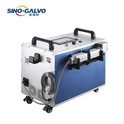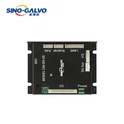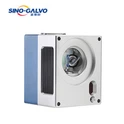


Denim finishing is a core post-production process for jeans manufacturing, which falls into two mainstream technical routes: traditional chemical washing and laser fading engraving. Conventional washing replicates natural worn-in textures via chemical auxiliaries and mechanical abrasion; laser engraving forms targeted fading and etched patterns with high-precision laser beams, emerging as the dominant eco-friendly solution for fast-turnaround mass production. This paper compares the pros, cons and industrial mass-production applicability of the two processes, with a special focus on the performance strengths brought by the Sino Galvo RF-8330-3D-1200 series 3D dynamic galvanometer scanner.
Traditional Denim Washing Process
Shared Pre-Treatments (Applicable to Both Washing and Laser Engraving)
Desizing: Raw denim fabrics are coated with sizing agents off the loom, which render the fabric rigid and impair dye absorption and laser light reactivity. Warm water mixed with dedicated desizing auxiliaries strips starch coatings to soften the substrate. This guarantees uniform fading outcomes in subsequent washing or laser processing and avoids uneven color defects.
Pre-Shrinking: High-temperature water pre-shrinking releases fabric shrinkage in advance to stabilize garment dimensions, preventing shape distortion during end-user washing and daily wear.
Major Categories of Washing Techniques
Stone Wash / Stone Grinding: Natural or artificial pumice stones are loaded into wash drums to tumble and abrade jeans, creating a muted vintage faded finish. Adjusting grinding duration delivers diverse effects ranging from subtle abrasion to heavy ripped distressing.
Enzyme Wash: Bio-cellulase mildly decomposes surface fibers and indigo pigments for even, soft fading with delicate suede-like nap. It balances long-term soft hand feel and retro worn aesthetics, and remains the primary mass-production washing method.
Sand Wash: Mechanical agitation with alkaline additives generates a subtle frosted white fuzz across the fabric, boosting fluffiness and next-to-skin comfort.
Snow Wash: Jeans are dry-tumbled with pumice saturated in potassium permanganate. Combined chemical oxidation and physical abrasion forms irregular speckled white snowflake marks for classic retro styling.
Custom Special Effect Treatments: Including manual/machine whiskering, spray monkey wash, distressing and ripping. Crease pressing, chemical spraying and manual cutting produce localized radial creases, gradient fading and torn rips for trendy personalized styles.
Key Drawbacks of Conventional Washing

Heavy Environmental Compliance Burden
The process heavily relies on hazardous chemicals such as potassium permanganate, sodium hypochlorite and dye auxiliaries, discharging massive volumes of high-concentration pigmented wastewater and pumice dust. Wastewater treatment incurs high overhead, while stringent global environmental regulations frequently restrict export order approvals.
Poor Batch Color Reproducibility
Final visual results are highly variable, affected by washing duration, chemical concentration, pumice wear and ambient temperature/humidity. Even within a single production batch, inconsistent shading and texture are common, failing strict quality standards for premium apparel brands.


Limited Pattern Definition
It only achieves broad, blurred abrasion and faded areas, and cannot render high-detail graphics such as portraits, intricate logos, artistic illustrations or micro text, creating hard limits on creative design execution.
Low Production Efficiency & Rising Labor Costs
Washing involves lengthy multi-stage workflows: desizing, aging treatment, neutralization and softening, extending lead times and delaying deliveries. Labor-intensive steps like sand spraying and hand rubbing drive steady annual labor cost hikes and inflate overall manufacturing expenses.

Laser Engraving Process (With Sino Galvo RF-8330-3D-1200 Galvanometer Scanner)
Laser denim engraving serves as a digital, eco-friendly replacement for traditional chemical washing. Its working principle relies on a CO₂ laser emitting 10,600 nm infrared beams focused by a galvanometer system. Instant thermal energy vaporizes surface indigo pigment to form faded patterns; elevating laser power etches fiber structures for hollow-out rips and distressing without damaging the base fabric, retaining both texture and garment

Standard Production Workflow
Import design files (vector / bitmap) → Tune laser power & scanning speed based on denim weight and shade → Dynamic focusing scanning via Sino Galvo RF-8330-3D-1200 galvanometer → Pattern forming → Optional light rinse for dust removal → Final setting & finishing.
Core Hardware: Unique Advantages of Sino Galvo RF-8330-3D-1200 Series Galvanometer
The galvanometer scanner acts as the core motion control unit of laser engraving equipment, directly determining engraving precision, maximum working area and cross-batch consistency. Custom-engineered exclusively for the denim industry, the Sino Galvo RF-8330-3D-1200 outperforms ordinary galvanometer models across all key metrics:
Ultra-Large Single-Pass Working Area for Higher Throughput: Its full 1200×1200 mm effective scanning zone eliminates segmented stitching. Full-pant full-surface patterns, full-leg whiskering and large-area gradient monkey wash effects can be processed in one pass, erasing stitching misalignment and pattern discontinuity while drastically cutting workpiece loading/unloading frequency.
Native 3D Global Dynamic Focusing for Uniform Precision on Curved Surfaces: Built-in 3D dynamic focusing auto-compensates focal length for denim's uneven curved geometry - pant leg arcs, pocket contours and waistband folds. It delivers ±0.05 mm full-field positioning accuracy, 99.9% linearity and thermal scale drift below 40 PPM/°C. Engraving clarity stays uniform across all surface heights, resolving blurry edges and distorted details common to standard 2D galvanometers.
High-Speed Digital Servo Scanning for Stable Mass Continuous Production: Equipped with high-response digital servo drives and zero drift under 15 μRad, it avoids pattern warping or jagged outlines during high-speed scanning. Single jeans engraving takes merely 20–40 seconds. No thermal drift or shade deviation occurs during long-hour nonstop operation, guaranteeing identical output across thousands of pieces and satisfying strict mass-production QC criteria.
Universal Fabric Compatibility to Unlock Unlimited Design Creativity: Fully compatible with light-wash, dark indigo, black and heavyweight denim variants. It reproduces all classic washed aesthetics including soft whiskers, gradient monkey wash and snowflake distressing, while delivering ultra-fine intricate graphics impossible to achieve via chemical washing: portraits, elaborate brand logos, multi-layer gradients and micro-sized text.
Industrial-Grade Robustness for Harsh Factory Operating Conditions: Supports stable operation across a wide ambient temperature window of 0°C–45°C. Dustproof and anti-vibration structural design fits denim factories' dusty, round-the-clock operating environments. Low failure frequency reduces long-term maintenance expenditure compared to traditional washing machinery.
Comprehensive Advantages of Laser Engraving Technology

Eco-Conscious & Globally Compliant
No bleaching or dye chemicals required. Water consumption cuts by 95% versus traditional washing, and power consumption equals only 1/6 of conventional heat transfer printing. Zero wastewater and particle emissions satisfy international environmental standards, making it ideal for high-value export apparel lines.
Digitalized QC Eliminates Cross-Batch Color Deviation
All processing parameters are digitally locked and controlled.
Supported by the high-repeatability RF-8330-3D-1200 galvanometer, every finished garment features identical pattern positioning, fading depth and dimension, completely solving the inconsistent color flaw inherent to chemical washing.


Ultra-Fast Pattern Switching for Flexible Custom & Quick-Order Production
Pattern replacement takes only 3 minutes, with no pumice replacement or chemical mixing needed. It seamlessly supports both large-volume bulk orders and small-batch fast-response personalized customization.
Streamlined Workflow Reduces Labor Input & Shortens Lead Time
Multi-stage washing, neutralization and manual hand-rubbing steps are eliminated. Desized, dried jeans can go straight to laser engraving, lowering labor reliance, shortening production cycles and guaranteeing on-time shipment.

Limitations of Laser Engraving
Intense laser heat slightly scorches surface fibers, creating a stiffer hand feel for full-area heavy engraving. High-power processing on thick black denim demands precise parameter tuning to prevent yarn carbonization and brittleness. Digitally generated gradient textures lack the subtle soft haze of premium hand-spray monkey wash. For balanced results, we recommend pairing high-definition laser patterns with mild enzyme washing to soften fabric tactility.
Process Selection Guidance for Mass Production
If your product positioning focuses on retro soft worn-in finishes, ultra-comfortable hand feel and low-cost basic jeans: adopt traditional enzyme washing paired with manual special effect treatments.
If you require ultra-fine graphic detailing, eco-compliant export orders, standardized large-batch production or small-lot fast turnaround: CO₂ laser engraving integrated with the Sino Galvo RF-8330-3D-1200 galvanometer scanner is the optimal solution.
Industry Premier Hybrid Solution: Deploy the RF-8330-3D-1200 galvanometer laser to produce intricate patterns and 3D whisker textures, followed by mild enzyme washing to soften fabric. This combination balances ultra-high precision, authentic vintage aesthetics and premium wearing comfort.