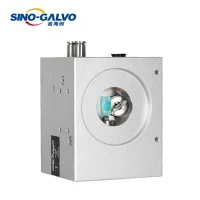


Galvanometer scanning systems are usually used in laser industrial processing, medical treatment, scientific research and measurement applications. After collimation or beam expansion, the laser beam is incident on the galvanometer lens in the X and Y directions, and then focused on the working surface through the F-theta lens. At the same time, the incident angle of the beam and the position of the spot on the image plane satisfy a linear relationship, so that the position of the focused spot on the image plane is controlled by controlling the scanning angle of the incident beam.

Unlike ordinary imaging objectives, the image height of the F-Theta lens is proportional to the angle of view. The field of view, focal length and image height of the lens shown in Figure 2 satisfy the relationship shown in the following equation:
y = f × θ
In the formula, θ, f, and y respectively represent the angle of view, focal length and image height of the F-Theta lens. When the focal length of F-Theta is constant, the image height y is proportional to the field of view θ, which satisfies the linear relationship.

Several significant parameters related to the field lens are incident laser wavelength, scanning format, field lens focal length, incident laser aperture, and focus spot size. Common field lens models such as SL-1064-110-163Q-D10. 1064 indicates that the laser wavelength is 1064 nm, Nd: YAG laser; 110 indicates that the field lens scan area is 110 mm×110 mm; 163 indicates that the field lens focal length is 163 mm; Q indicates that the field lens material is all quartz, and quartz absorbs less laser light and has a small temperature drift; D10 indicates that the diameter of the laser incident beam is 10 mm .
When choosing a field lens, you need to pay attention to the relationship between various parameters; mastering its use skills can prolong the service life of related optical components.
1)
The relationship between focal length and format:
L = f × 2θ
Where L is the diagonal length of the square scanning format, θ is the maximum optical deflection angle expressed in radians, and f is the effective focal length of the lens. By maximizing θ, the focal length of the system can be minimized. Generally, this is the preferred method to maintain L, because it can reduce the size of optical components, thereby building a more compact and cost-effective system.
In addition, the f-theta distortion caused by the instability of the scanning mirror motor can also be reduced, because these distortions are proportional to the EFL (the smaller the EFL, the smaller the distortion). One thing to mention here is that the maximum optical deflection angle represented by θ is different from the maximum optical deflection angle of the galvanometer. Taking scanlab 10 galvanometer as an example, its maximum optical deflection angle is ±0.35 rad, which is ±20°, and θ is ±28.28°. Therefore, when designing a field lens, one should not blindly pursue a small focal length and a large format of the field lens. It is necessary to consider whether the deflection angle of the galvanometer can reach the required value and the design cost.
2)
Focus spot size formula
Spot size = 1.83×λ×f/D
Generally, when designing a field lens, the focused spot is within the diffraction limit, where λ is the laser wavelength, f is the effective focal length of the lens, and D is the incident beam diameter at 1/e2. 1.83 is a constant, which is related to the pupil illumination and the degree of input interception (for Gaussian beams, when the incident beam is intercepted at 1/e2 diameter, 1.83).
If there is a requirement for the focus spot size, you can select the appropriate field lens focal length and incident beam diameter according to this formula.
3)
Back point and inner point of field lens
In order to achieve better flat field performance, most of the field lenses use multi-lens design. The energy of the back reflection point of the laser on the lens surface is highly concentrated. With the continuous increase of laser power in industrial use, if the back reflection point is focused on X, Y On the vibrating lens ,the reflective film layer of the vibrating lens will be ablated, resulting in a significant decrease in the system transmittance.

If the internal reflection point is focused on the inner lens of the scanning mirror, it will cause a significant thermal lens effect. The refractive index of the lens changes with the accumulation of energy, directly changing the working distance of the scanning mirror, which reflects that the marking spot becomes larger, the marking color becomes lighter or even unable to be marked. Different field lens design manufacturers will give the data of all the back reflection points of a field lens in different ways. The back reflection point is the inherent data of a field lens and has nothing to do with the galvanometer. When the field lens and the galvanometer are used together, whether it is directly connected or connected through an adapter ring, you should pay attention to the distance between the back reflection point and the galvanometer X and Y film to avoid the back reflection point directly on the galvanometer lens. When connecting the ring, ensure that the distance between each back point and the vibrating lens is more than 3 mm.

In addition, when the back reflection point data is too large, attention should be paid to the influence of these back reflection points on the optical components in front of the galvanometer. When the galvanometer and field lens are used in conjunction with an adapter ring, the length of the adapter ring is limited:
(1) Install the transfer ring, avoid the return point;
(2) The adapter ring is too short, the field lens and the galvanometer mechanical part will interfere;
(3) If the adapter ring is too long, the scanning format will be reduced. Therefore, in order to reduce the limitation of the adapter ring length, it is better to leave a margin when choosing the field lens format.
4)
Telecentric angle of field lens
The telecentric angle of the field lens refers to the angle between the optical axis of the beam after the edge light passes through the field lens and the working surface. Field lens is generally divided into ordinary field lens and telecentric field lens. The telecentric angle of ordinary field lens is 4°-17°; the telecentric angle of telecentric field lens is 0°-4°. The advantage of the telecentric field lens is that the focal spot size of the entire format is the same, and it is mainly used in applications such as precision marking (the marking effect is the same at the edge and the middle) and cutting (the OLED screen is more vertical).

When there is coaxial vision monitoring in the optical path, the imaging effect of the telecentric field lens is better than that of the ordinary field lens. The smaller the telecentricity, the more the number of lenses used, the larger the lens diameter, and the higher the price of the field lens. The telecentric angle of the field lens should be selected according to actual needs.
5)
Field lens all-quartz design and water cooling
Quartz has good thermal stability, low hydroxyl, and high transmittance to ultraviolet, green, semiconductor and Nd:YAG lasers. Therefore, many field lenses are designed for all-quartz. However, the refractive index of quartz is lower than that of most glasses, so the number of all-quartz field lenses is larger than that of all-glass designs, and the price is higher. For the high-power 1064 nm laser, the field lens must also be designed with water cooling, high-power coating, enhanced heat dissipation, and reduced absorption.
6)
Damage threshold

Continuous laser and pulsed laser have different requirements for laser damage threshold. Continuous laser (W/cm2) and pulsed laser (J/cm2) are related to laser pulse width and repetition frequency. Pulse lasers generally give pulse width, peak power and repetition frequency, which can be calculated as follows:
Pulse energy = peak power × pulse width
Average power = pulse energy × repetition frequency
Power density = average power / spot area
Energy density = pulse energy / spot area
When the damage threshold of the field lens is more than twice the damage threshold of the laser, the use of the field lens is safe. It is actually difficult to judge the field lens's resistance to laser damage. In addition to theoretical calculations, it is also necessary to consider factors such as lens absorptivity, surface roughness, smoothness, ultra-smooth processing, elimination of internal reflection in design, etc., and a large amount of experimental data is needed. Therefore, the above are just some theoretical concepts to guide its design and manufacturing.