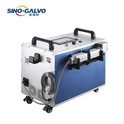


In modern industrial laser applications, we are constantly exploring whether laser technology can be applied in more other industries.In the clothing processing industry, clothing fabrics are widely used and require precise and diverse processing. Laser processing has become a common processing technology for clothing fabrics, such as fabric cutting, pattern cutting, accessory cutting, pattern marking, anti-counterfeiting marking, etc. This article summarizes the laser engraving effects and parameter settings of different types of fabrics in the clothing industry.
Laser Drilling on Leather
Leather is a common and widely used clothing fabric, involving a wide range of products such as bags, wallets, leather shoes, leather jackets, seats, sofas, etc. Drilling holes in leather is also a common method used by leather technicians. Usually, leather drilling is used on the surface of seats, decoration of leather shoes and clothing, and so on. When drilling leather, there are very precise requirements for the size of the aperture, usually requiring a diameter between 1mm-2mm. Laser processing can meet these processing requirements without affecting the surface of the leather.

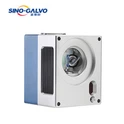
Sino Galvo has a high-performance10600nmRF 3D galvanometer, RF8330-3D-1200, which can perform laser marking, laser cutting, and more. When drilling leather, there are some important parameters that need special attention to be set, such as frequency, power, and speed.
|
Laser Drilling on Leather Parameters Setting |
|||
|
Laser |
Frequency |
Power |
Speed |
|
100w CO2 |
5 Khz |
90% |
400mm/s |
After laser drilling, there is no heat affected zone on the surface of the leather material, the aperture size meets the requirements, and the penetration is uniform.

In the process of laser drilling leather, the aperture size, drilling format, and shape can be customized, which is a very efficient processing method for leather fabrics.
Laser Engraving on Vegetable-tanned Leather
Vegetable tanned leather is a material formed by processing leather with vegetable tanning agents, and belongs to a subdivision of first layer cowhide. The main uses of vegetable tanned leather include handbags, backpacks, horse gear, insoles, shoe linings, hat edges, belts, and other leather products that can directly come into contact with the human body.
For surface laser treatment of tanned leather, a CO2 laser with a wavelength of 10600nm is usually used for engraving.

|
Laser Engraving & Cutting on Leather Parameters Setting(Coffee Coaster) |
|||
|
Laser |
Cutting Power |
Cutting Speed |
Cutting Times |
|
60W CO2 |
100% |
170mm/s |
6 |
|
Marking Power |
Marking Speed |
Marking Times |
|
|
60% |
600mm/s |
1 |
|
When making coffee coasters, Sino Galvo used a 60W CO2 laser to carve and then cut, achieving uniform cutting edges without adhesion, and no heat affected zones or deformations on the carved surface.
Laser Marking on Denim Fabric
Denim is a coarse and thick color woven twill cotton fabric, which is a common clothing fabric with a wide range of uses. The processing methods for denim fabrics usually include washing, bleaching, brushing, acid treatment, coating treatment, etc. Among them, laser printing on denim is also a common processing method.

The advantages of using laser for denim printing include fast processing speed, small heat affected zone on the fabric, the ability to achieve large format processing, and flexible processing.
|
Laser Engraving on Denim Parameters Setting |
|||
|
Laser |
Frequency |
Power |
Speed |
|
100w CO2 |
5 Khz |
7% |
2500mm/s |
For this test, we used a 100W CO2 RF laser in conjunction with Sino Galvo high-performance 3D galvanometer RF8330-3D-1200, which can achieve laser printing processing of denim fabrics.
The RF8330-3D-1200 galvanometer can achieve a maximum marking width of 1200mm and can be applied to the processing of most non-metallic materials, such as clothing fabrics, wood, slate, leather surfaces, acrylic plastic surfaces, etc.
Large Format Laser Marking on Denim Fabric(1200 x1200mm)
As mentioned earlier, CO2 RF laser can be used for laser printing of denim fabrics. Currently, Sino Galvo Tech can achieve 1200mm marking, with clear marking boundaries, small heat affected zone on the material surface, fast processing speed, and high efficiency.

Laser Cutting on Suede Fabric
Suede is an animal leather product, and in recent years, due to environmental reasons, synthetic suede materials have emerged. Most suede like materials are synthesized from PET plastics such as polyester fibers. As environmentally friendly fabrics, they are now widely used in the clothing industry, such as bags, clothing accessories, shoes and hats.
For the processing of this suede like fabric, we used laser cutting to form 3.5x5mm wide tassel strips.

|
Laser Cutting on Suede Parameters Setting |
|||
|
Laser |
Frequency |
Power |
Speed |
|
100w CO2 |
5 Khz |
60% |
600mm/s |
After laser cutting, we found that the cutting surface is uniform, there is no heat affected zone, and the processing efficiency is high.
Laser Cutting on PU Plastic Heat Transfer Film
PU heat transfer film is a type of plastic product. After laser cutting logos or patterns, the film is printed onto clothing or fabrics using a hot press machine, with certain requirements for the integrity of the laser cut edges.

There are various materials for heat transfer film, commonly including PU, PET, silicone, etc. By utilizing the cold light source characteristics of UV laser, pattern cutting can be effectively carried out with minimal thermal impact. Capable of achieving high efficiency and high-speed large-scale processing requirements.
Conclusion
In summary, the use of laser galvanometers in the clothing industry, such as laser cutting, laser marking, etc., requires the selection of different lasers and galvo for different materials in order to achieve optimal processing requirements.
The advantages of laser galvo processing clothing fabrics include:
1. Fast processing speed, laser cutting of fabrics is fast and efficient.
2. Less waste: Non-contact processing, laser cut fabric does not deform, high precision, and neat cuts.
3. Save fabric: During laser cutting, the samples to be cut can be arranged closely together, resulting in high fabric utilization.
4. Flexible processing : The laser beam is not limited by any shape during operation.
5. Strong adaptability: The energy and movement speed of the laser beam can be adjusted, and the heat affected zone of laser processing 6. can be adjusted according to processing requirements.