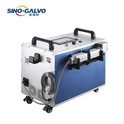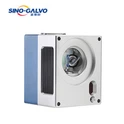


Fiber laser
Principle: Optical fiber is usually glass solid fiber drawn from SiO2 as the matrix material. It is widely used in optical fiber communication. The principle of light guiding is the mechanism of total internal reflection of light. Ordinary bare optical fiber is generally composed of a high refractive index glass core in the center, a low refractive index silica glass cladding in the middle, and an outermost reinforced resin coating.
Optical fiber can be divided into single-mode fiber and multi-mode fiber. Single-mode fiber: The center glass core is thin, and can only transmit one mode of light. Its inter-mode dispersion is very small, and it has the functions of optional mode and mode limiting. Multimode fiber: The central glass core is thicker and can transmit multiple modes of light, but the dispersion between the modes is large, and the transmitted light is not pure.

Advantages: Fiber laser has the characteristics of small size, low energy consumption, long life, high stability, maintenance-free, multi-band, and green environmental protection. It has superior beam quality, stable performance, and ultra-high photoelectric conversion efficiency. Won the affirmation of many people in the laser industry. Fiber lasers have established a new standard for the laser processing industry with its ultra-high reliability, excellent beam quality, and low operating cost.
It has long gain medium, high coupling efficiency, good heat dissipation, simple and compact structure, flexible and convenient use, good output laser beam quality and wide output wavelength range.
1. High-power fiber lasers are all double-clad fibers. The pump light hits the outer cladding, and the energy is absorbed and partly converted into laser. Therefore, the material and structure of the cladding have a great influence on the fiber laser. At present, various countries have developed Optical fibers of various shapes include round, D-shaped, rectangular, unstable cavity, quincunx, square, flat thread, etc.
2. No thermoelectric cooler is needed. This high-power wide-face multimode diode can work at a very high temperature. It only needs simple air cooling and has low cost.
3. A wide pump wavelength range. The active cladding fiber in a high-power fiber laser is doped with erbium/ytterbium rare earth elements, and has a wide and flat light wave absorption region. Therefore, the pump diode does not need any type of wavelength stability Device
4. High efficiency The pump light traverses the single-mode fiber core many times, so its utilization rate is high.
5. High reliability, using branch fiber direct fusion splicing coupling for side pumping, one does not need any optical components, two can avoid damage to the fiber end face, and third, it is easy to improve the injection of the pump source. Novel centipede side pumping method: Many fiber branches on both sides of the fiber are directly fused with LD pigtails, and a single pump is performed from different points, which can avoid the nonlinear effect and mode deterioration caused by a single point of strong laser.

Using multiple high-power LD single tubes instead of LD integrated array as the pump source, one can improve the mode of the light source, the second is easy to heat the pump source and increase the life, and the third is conducive to maintenance and replacement. Using an LD with a wide light-emitting surface as a pump source can greatly reduce the optical power density of the LD's light-emitting point and increase its life span, generally up to 100,000 hours.
Application: Fiber laser consumes only 1% of the electric energy required by lamp pump laser, and its efficiency is more than twice that of semiconductor pump solid laser.
The combination of higher efficiency, longer service life, and less maintenance makes the cost of fiber laser owners extremely attractive. Fiber lasers are very useful in laser applications that require high near-infrared beam quality. They will have special interest in small focusing spot and high power density, such as desktop production. A beam of 100W laser output spot can be focused to as small as 5um, which is equivalent to a brightness of 109W/cm2.
Fiber lasers have a wide range of applications, including laser fiber communication, laser space telecommunication, industrial shipbuilding, automobile manufacturing, laser engraving, laser marking, laser cutting, printing rollers, metal and non-metal drilling, cutting, welding, fiber lasers It can be used as a military laser beacon light source; in naval equipment, fiber lasers can be used for submarine communication, torpedo detection, sea depth measurement, underwater sensing and sea-based optical control weapons. and national defense security, medical equipment and equipment, large-scale infrastructure, etc.

Disadvantages: The price is relatively high, usually only limited to the field of metal processing, and it is unlikely to make a difference in non-metal processing. Such as materials such as plastic, paper or cloth. These industries will continue to be dominated by CO2 lasers. Compared with traditional laser cutting machines, the advantages of fiber cutting can be flat cutting or bevel cutting, and the edges are neat and smooth, and it is suitable for high precision such as metal plates and glass. Cutting processing. Compared with the ordinary carbon dioxide laser cutting machine, it saves more space and gas consumption, and has a high photoelectric conversion rate. It is a new energy-saving and environmentally-friendly product and one of the world's leading technological products.
Fiber laser cutting machine has extremely high electro-optical conversion efficiency. Its electro-optical conversion efficiency reaches 25%, which is several times higher than that of traditional laser cutting machine. However, the overall operating cost is only 15% of traditional laser cutting machine. At the same time, the size of the fiber laser cutting machine is small, the laser generator covers an area of less than 1 square meter, and the overall area is about 50 square meters, which is two-thirds of the traditional laser cutting machine.
YAG laser
Principle: YAG laser is a solid-state laser based on yttrium aluminum garnet crystal. The chemical formula of yttrium aluminum garnet is Y3Al5O15, abbreviated as YAG. Like other solid-state lasers, the basic components of YAG lasers are laser working material, pump source and resonator.
However, due to the different types of active ions doped in the crystal, different pump sources and pumping methods, different structures of the resonant cavity used, and different other functional structural devices used, YAG lasers can be divided into many types. For example, according to the output waveform, it can be divided into continuous wave YAG laser, repetitive frequency YAG laser and pulsed laser; according to the working wavelength, it can be divided into 1.06μm YAG laser, frequency doubled YAG laser, Raman frequency shifted YAG laser and tunable YAG laser, etc.; Different doping can be divided into Nd:YAG laser, Ho, Tm, Er, etc.YAG laser; according to the shape of the crystal, it can be divided into rod-shaped and slab-shaped YAG lasers; according to the different output power, it can be divided into high power and medium and small Power YAG laser, etc.

The solid-state laser cutting machine expands, reflects, and focuses a pulsed laser beam with a wavelength of 1064nm, and then radiates and heats the surface of the material. The surface heat diffuses to the inside through heat conduction, and the width, energy, peak power and repetition frequency of the laser pulse are precisely controlled by digitalization. With other parameters, the material can be melted, vaporized and evaporated instantly, so that the cutting, welding, and drilling of the predetermined trajectory can be realized through the numerical control system.
Features: The machine has good beam quality, high efficiency, low cost, stability, safety, more precision, and high reliability. It integrates cutting, welding, punching and other functions. It is an ideal precision and efficient flexible processing equipment.

The processing speed is fast, the efficiency is high, the economic benefit is good, the straight side slit is small, the cutting surface is smooth, and the large aspect ratio and aspect ratio can be obtained. The thermal deformation is very small, and it can be performed on various materials such as hard, brittle, and soft There are no tool wear and replacement problems in processing, and it is easy to realize automation without machinery. It can achieve high processing pumping efficiency under special conditions, up to about 20%. As the efficiency increases, the thermal load of the laser medium decreases, so the beam is greatly improved Long quality life, high reliability, small size, light weight, suitable for miniaturization applications.
Application: Suitable for laser cutting, welding and drilling of metal materials: such as carbon steel, stainless steel, alloy steel, aluminum and alloys, copper and alloys, titanium and alloys, nickel-molybdenum alloys and other materials. Widely used in aviation, aerospace, weapons, ships, petrochemical, medical, instrumentation, microelectronics, automotive and other industries. Not only the processing quality is improved, but also the work efficiency is improved; in addition, the YAG laser can also provide a precise and fast research method for scientific research.
Compared to other lasers
1. YAG laser can work in two modes: pulse and continuous, and its pulse output can be obtained by Q-switching and mode-locking technology to obtain short pulses and ultra-short pulses, so that its processing range is larger than that of CO2 lasers.
2. Its output wavelength is 1.06um, which is exactly an order of magnitude smaller than the CO2 laser wavelength 10.06um, so it has high coupling efficiency with metal and good processing performance
3. YAG laser has compact structure, light weight, easy and reliable use, and low maintenance requirements.
4. YAG laser can be coupled with optical fiber, and with the help of time division and power division multiplex system, a laser beam can be easily transmitted to multiple stations or remote distance stations, which is convenient for laser processing to achieve flexibility.
Therefore, in the selection of lasers, various parameters must be considered, as well as their own actual needs. Only in this way, can the laser display its maximum efficiency.