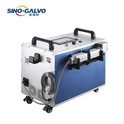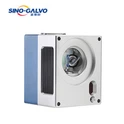


At present, China's traditional manufacturing industry is facing a deep transformation and upgrading. Laser technology has got more and more recognition in the market. Laser precision machining can be divided into four types of applications: precision cutting, precision welding, precision drilling and surface treatment.
Laser precision cutting
Laser precision cutting uses pulse laser beam to focus on the surface of the processing object, the formation of a high energy density spot, to instantaneous high temperature melting or gasifying of the processed material. Its processing characteristics are high speed, smooth and flat cuts, and generally without subsequent processing; the cutting heat affected zone is small, and the plate deformation is small: high processing accuracy, good repeatability, no damage to the surface of the material.

In the production process of cell phone screen cutting, fingerprint identification chip, LED invisible chip and other high precision requirements of the production process, laser precision cutting technology has incomparable advantages.
Laser precision welding
Laser precision welding is to radiate a high-intensity laser beam to the working area of the processed products. Through the interaction between the laser and the material, the welded place can quickly form a multi-density concentrated heat source area. The heat energy melt the area to be welded and cool down and crystallize to form consolidated welding spots or welds. Its characteristic is that it doesn’t require electrodes and filling materials, and is non-contact welding. It can weld refractory metal with high melting point or material with different thickness.

In the 3C field, all types of mobile phone modules and mid-board covers are inseparable from laser precision welding technology.
Laser precision drilling
Laser precision drilling is to reduce the spot diameter to micron level, so as to obtain high laser power density, laser drilling can be implemented in almost any material. Its characteristics are that it can punch holes in materials with high hardness, brittle or soft material, small aperture, fast processing speed and high efficiency.

Laser perforation is the most widely used in the PCB industry. It can also drill small holes, micro holes and invisible holes below 2 μm that cannot be achieved with traditional equipment. On the surface of electronic products, it can also be used for drilling holes in cell phone speakers, microphones and other glass.
Laser surface treatment
Laser surface treatment is the use of high-power density laser beams to surface-treat metals, which can achieve phase-change hardening, surface amorphous, surface alloying, or chemical reactions that vaporize or change the color of surface materials, so as to change the surface characteristics of metal materials. Its characteristics are that no need to use additional materials, and only changes the organization structure of the surface layer of the processed material, the processed part is minimal and is suitable for surface marking and high-precision part processing.