



What is LiDAR? Why Galvanometer scanner Is Important for ADAS Lidar and Autonomous Sensing?
This article will explain the lidar application and Importance of laser galvanometer from five aspects: 1) What is LiDAR; 2)A comparison of Camera, Radar, Lidar, and Inertial Navigation System;3)LiDAR Classification;4)LiDAR Application;5)The Principle of Galvanometer application in ADAS Lidar.
What is LiDAR?
LiDAR was developed by NASA to track satellites and space distances. But since the 1990s, lidar systems have become smaller and even more accurate. This made lidar being an attractive option for adding "eyes" to autonomous vehicles, as the vehicles need to rapidly develop an image of the world surrounding them to avoid hitting pedestrians, animals, obstacles, and other vehicles.
LiDAR, short for laser Detection and Ranging, is a sensor that uses laser to achieve accurate distance measurement. LiDAR emits laser pulses which are reflected back when they encounter surrounding objects, and by measuring the time it takes for the laser to reach each object and return to it, the exact distance to the object can be calculated. LiDAR emits thousands of pulses per second, and by analyzing the amount of reflected energy on a target’s surface, amplitude, frequency, and phase of the reflected wave spectrum. collecting these distance measurements, 3D environment modeling has been constructed, known as a point cloud.
A comparison of Camera, Radar, Lidar, and Inertial Navigation System
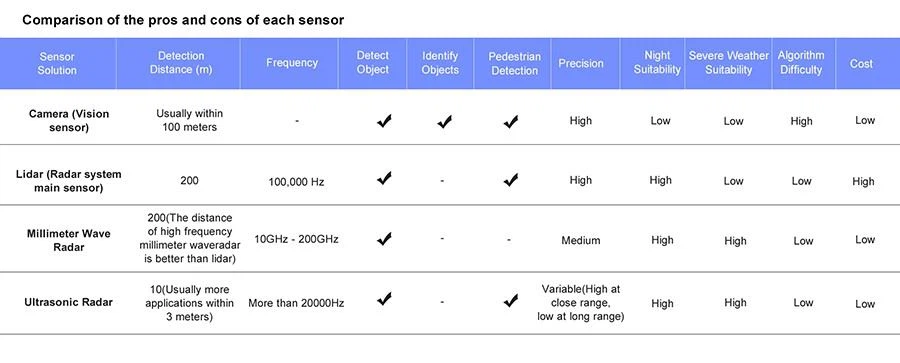
Lidar recognizes obstacles, positioning, navigation and environment through laser beam reflection. The advantages are 1) High-definition 3D modeling; 2) With a single point ranging principle and a wavelength of 1550nm, it can have a detection range of around 200 meters; 3) The polyhedron speed is maintained at the level of 100Hz, and the galvanometer frequency is maintained at kHz level, which can achieve a lidar resolution of more than 100 lines. However, it is highly sophisticated and expensive.
Camera is to use the computer to identify the surrounding environment, people, cars, objects and judge the distance ahead of the car. The advantages are 1) Low cost and Vision-like sensory; 2) Recognizing 2D information. However, it relies on sample training, the pedestrian identification is unstable and poor vision under extreme weather events.
Millimeter-wave Radar use radio waves to sense the driving situation in a wide range of vehicles, mainly used in adaptive cruise control, blind-spot warning, collision warning and collision prevention system. The advantage is the default sensor for emergency braking, but the definition modeling is quite low, only could recognize the obstacles, cannot accurately describe their size and shape,detect pedestrians.
Inertial Navigation System is made up for the positioning defects of GNSS and accurately perceive vehicle position. The advantages are 1) Less interference from outside; 2) High accuracy and stability. However, the cost is high, also the time perception cannot be independent of GNSS.
LiDAR Classification

Classification 1: Laser emission waveform (Continuous and Pulsed LiDAR)
Continuous LiDAR is one that has light coming out all the time, just like switching on a torch, its light will always be on (except in special cases). Continuous lasers rely on a continuous bright light to the altitude to be measured for data acquisition at a certain altitude. Due to the operating characteristics of the continuous laser, data can only be collected at one point at a given time. Because of the uncertain nature of wind data, using one point to represent the wind conditions at a certain height is obviously somewhat one-sided. Some manufacturers, therefore, compromise by taking a 360-degree rotation and collecting multiple points on top of this circular edge for averaging assessment, which is obviously a concept of multi-point statistics in a virtual plane.
Pulsed LiDAR output is not continuous, but flickers. The principle of the pulsed laser is to emit tens of thousands of laser particles and, according to the internationally accepted Doppler principle, to evaluate the wind conditions at a certain height from the reflection of these tens of thousands of laser particles, which is a three-dimensional concept, hence the theory of detection length. This is a three-dimensional concept, hence the theory of detection length. By the nature of the laser, a pulsed laser can measure dozens of times more points than a continuous laser, and can more accurately reflect the wind conditions at a given height.
Classification II: Detection Modes (Direct Detection LiDAR and Coherent Detection LiDAR)
The basic structure of a direct detection LiDAR is quite similar to that of a laser rangefinder. In operation, a signal is sent by the transmitting system, reflected by the target and collected by the receiving system, and the distance to the target is determined by measuring the time taken for the laser signal to travel back and forth. The radial velocity of the target can be determined from the Doppler shift of the reflected light, or the velocity can be found by measuring two or more distances and calculating the rate of change.
Coherent Detection LiDAR In a so-called monostable system, the transmit and receive signals share a common optical aperture and are isolated by a transmit-receive switch. In contrast, a bistable system consists of two optical apertures, one for the transmit and one for the received signal, and naturally, the transmit-receive switch is no longer required, the rest is the same as in a monostable system.
Classification III: Number of vertically aligned lines (Single and Multi-line radars)
Single-line radar: can only acquire 2D information and is mostly used in indoor robots in the corner, e.g. floor sweepers.
Multi-line radar: mostly used for 3D reconstruction, expensive. Conventional is 2.5D and can be done in 3D.
Classification IV: Mechanical structures (Mechanical LiDAR and Solid-state LiDAR)
Mechanical LiDAR: with a rotating part to control the angle of laser emission. The laser emission angle is adjusted by a mechanical rotating mechanism and the product is relatively mature. Mainly composed of photodiodes, MEMS mirrors, laser emission receiving devices, etc., where the mechanical rotating part is the MEMS emission mirror that can control the laser emission angle by 360°.
Solid-state LiDAR: No mechanical rotating parts are required, relying mainly on electronic components to control the laser emission angle.
Classification V: Scanning methods (mechanical, rotoscope, MEMS, OPA and Flash)

Mechanical LiDAR It rotates at a certain speed and uses mechanical 360° rotational scanning in the horizontal direction and directional distributed scanning in the vertical direction to gather dynamic information. Mechanical rotational LiDAR systems are complex and expensive in terms of core components, including lasers, scanners, optical components, photodetectors, receiver ICs and position and navigation devices. The high hardware costs make mass production difficult and stability needs to be improved.
The rotating mirror (semi-solid-state) LiDAR keeps the transceiver module immobile, allowing the motor to reflect the beam into a certain area of space as it moves the rotating mirror, thus enabling scanning detection, similar in technical innovation to the mechanical LiDAR.
MEMS-type LiDAR (semi-solid-state): (Micro-Electro-Mechanical System) can dynamically adjust their scanning pattern to focus on specific objects, picking up details and identifying smaller objects at greater distances than is possible with conventional mechanical lidars. reflector to direct a fixed laser beam in different directions. Because the reflector is so small, it does not have a large moment of inertia and can move quickly enough to track to 2D scanning mode in less than a second.
The Optical Phased Array OPA (solid-state) uses the principle of coherence to deflect the emitted beam by applying a voltage to regulate the phase relationship of each phased unit, thus completing the system to measure a certain range of scanning in space.
Flash-type LiDAR (solid-state) records the entire scene quickly, avoiding all the hassle of moving the target or the LiDAR during scanning, and it operates more like a camera. The laser beam is diffused directly in all directions so that the entire scene can be illuminated with a single flash. The system then uses an array of miniature sensors to capture the laser beams reflected back in different directions. flash LiDAR When the pixels are larger, more signals need to be processed, and cramming a huge number of pixels into a photodetector will inevitably introduce all sorts of interference, with the result being a loss of accuracy.
Classification VI: Load platforms (airborne, vehicle-based, ground-based and satellite-based)
Airborne LiDAR is a technology that closely integrates laser ranging equipment, GNSS equipment and INS, and uses the flying platform as a carrier to obtain three-dimensional information on the ground surface by scanning the ground, recording information on the attitude, position and reflected intensity of the target, and processing it in depth to obtain the required spatial information. It has a wide range of potential and prospects in both civil and applications. Airborne LiDAR detection distance is close, when the laser is transmitted in the atmosphere, the energy is attenuated by the influence of the atmosphere, the action distance of LiDAR is within 20 km, especially in bad weather conditions, such as dense fog, heavy rain and smoke, dust, the action distance will be greatly reduced, it is difficult to work effectively. Atmospheric turbulence can also reduce the accuracy of LiDAR measurements to varying degrees.
Vehicle-mounted LiDAR, also known as a vehicle-mounted 3D laser scanner, is a mobile 3D laser scanning system that can calculate the relative distance between the target object and the vehicle by transmitting and receiving the laser beam, analyzing the folding time after the laser encounters the target object, and using the 3D coordinates of a large number of dense points on the surface of the target object collected, reflectivity and other information to quickly reconstruct the 3D model of the target and various figure data. The 3D point cloud map is created and the environment is mapped to achieve the purpose of environmental awareness. The role of LiDAR in autonomous driving is becoming increasingly important, with companies such as Google, Baidu, BMW, Bosch, and Delphi using LiDAR in their autonomous driving systems, driving the rapid expansion of the LiDAR industry.
Ground-based LiDAR can obtain 3D point cloud information of the forest area and use the point cloud information to extract single wood location and tree height, it not only saves manpower and material resources but also improves the accuracy of extraction, which has the advantage that other remote sensing methods can not be compared. Through the analysis of the forestry application of this technology at home and abroad and the verification of the results of the later stages of the research on this invention, this technology will be used to extract various forest parameters in a larger research area in the future.
The satellite radar, with its high orbit and wide observation field, can reach every corner of the world. It provides a new way of acquiring 3D control points and digital ground models in offshore areas, which is of great importance for both defense and scientific research. Lidar is also capable of observing entire celestial bodies and is included in programs such as the US Lunar and Mars exploration programs, providing data that can be used to produce comprehensive 3D topographic maps of celestial bodies. In addition, LIDAR can also play an important role in the measurement of the vertical distribution of vegetation, sea surface height, the vertical distribution of clouds and aerosols, and the monitoring of special climatic phenomena.
Through the above introduction of LIDAR features, principles and application areas, I believe that you can also generally understand the different attributes of various types of LIDAR. Right now, the most critical component for realizing high-level autonomous driving technology (L4 and above) is the LiDAR. This has almost become a default "axiom" in the autonomous driving engineering community, and creating a low-cost, mass-production LIDAR is a dream that many start-up companies want to realize.
LiDAR Application

In recent years, as smart cars continue to develop, LiDAR has gained more and more attention, especially with the different views and controversies between Tesla and other car companies on LiDAR, which has generated a lot of heat. However, as the "eyes" of the machine, LiDAR is not only used in automotive smart cars, but also in a wide range of applications, including logistics and transport, smart cities, V2X, robotics and industrial applications.
LiDAR Application in Industrial Manufacturing
Nowadays, more and more companies are committed to introducing robots into manufacturing and opening up automated production, and LiDAR just happens to gain ground in mobile robots and industrial automation processes. For AGV cars, LiDAR is a prerequisite for positioning, navigation and path planning travel, while in production lines it can also release material monitoring roles and safeguard automation.
And in the field of smart logistics, LiDAR applications are also increasing day by day. Whether from handling to storage or to logistics, LiDAR can be said to be able to cover all aspects. In warehousing, LiDAR can assist stacker cranes to achieve automatic access to goods; in logistics scenarios such as ports, LiDAR can also ensure the accuracy of cargo gripping, reduce the difficulty of personnel operations, and improve the efficiency and effectiveness of logistics handling and crating, which can be considered of significant value.
LiDAR Application in the field of Urban smart governance
In terms of smart transportation, LiDAR can assist the detection of high-speed toll booths to ensure that passing vehicles meet the requirements; in terms of smart security, LiDAR can also be the eyes of various security monitoring devices, deployed on train platforms, gates and other places where needed, thus ensuring real-time security of areas and scenes.
LiDAR Application in the Commercial sector
Applied to robots, LiDAR can help hotels, office buildings, shopping malls, hospitals and other scenes of food delivery, cleaning, disinfection and other s; also applied to parking poles, etc., can also help intelligent parking system more effective operation; as well as applied to a variety of screens, can also help multimedia interaction come true, to achieve screen interaction, to meet the user interaction experience.
The Principle of Galvanometer application in ADAS Lidar

Galvanometer scanner, is also called a Galvo scanning system. It consists of an X-Y optical scanning head, an electronically driven amplifier, and an optical mirror.
It plays a very important role in the lidar system. It is a vector scanning device with excellent performance and a special swing servo motor driven by high frequency. The galvanometer scanner forms the laser light source emitted by lidar into the surface through the two mirrors on the motor, to achieve the laser scanning imaging.
There are some features as below:
Galvanometer scanner: It performs vertical scanning by Galvanometer Mirror. One or more galvanometers can be used, the galvanometer angle can be changed. The goal is to combine field angles, such as field overlap, to encrypt the point cloud density of the central field of view, so-called ROI optimization;
The Polygon Mirror scans horizontally;
Source: 1550nm fiber laser. Multiple pairs of light source and the detectors working alternatively, or simultaneously covering different field angles. The purpose of using multiple transceiver pairs is to reduce the frequency
Other Related articles, please refer to below:
Why Can Lidar Realize Autonomous Driving Faster?
How Is Lidar Used For Industrial Ranging?