



Significant Advantages of Laser Cleaning Applications
Principle of Laser Cleaning
The scientific name of laser cleaning is laser ablation. Laser ablation or light ablation is the process of removing materials from solid (or sometimes liquid) surfaces by irradiating them with a laser beam. At low laser flux, the material is heated and evaporated or sublimated by the absorbed laser energy. At high laser flux, materials are usually converted to plasma.

Generally, laser ablation refers to the removal of materials with a pulsed laser, but if the laser intensity is high enough, the materials can be ablated with a continuous-wave laser beam. Deep ultraviolet excimer lasers are mainly used for optical ablation. The laser wavelength for optical ablation is about 200 nm.
The beam emitted by the laser is absorbed by the pollutant layer on the surface to be treated. The absorption of large energy forms a rapidly expanding plasma (highly ionized unstable gas) and produces shock waves. Shock waves break up pollutants and remove them
Advantages of Laser Cleaning

Compared with traditional cleaning methods such as mechanical friction cleaning, chemical corrosion cleaning, liquid-solid strong impact cleaning, and high-frequency ultrasonic cleaning, laser cleaning has five obvious advantages:
Advantages of environmental protection: laser cleaning is a "green" cleaning method, which does not need to use any chemical agent and cleaning solution. The cleaned waste is basically solid powder, small volume, easy to store, recyclable, no photochemical reaction, and no pollution. It can easily solve the problem of environmental pollution caused by chemical cleaning.
Effect advantage: the traditional cleaning method is often contact cleaning, which has mechanical force on the surface of the cleaned object, damages the surface of the object or the cleaning medium is attached to the surface of the cleaned object, which cannot be removed and produces secondary pollution. The nongrinding, non-contact and nonthermal effects of laser cleaning will not damage the substrate so that these problems can be solved.
Control advantages: the laser can be transmitted through optical fiber, cooperate with manipulator and robot, conveniently realize long-distance operation, and can clean the parts that are not easy to reach by traditional methods, which can ensure the safety of personnel in some dangerous places.
Convenience advantage: laser cleaning can remove various types of pollutants on the surface of various materials to achieve the cleanliness that conventional cleaning cannot achieve. It can also selectively clean the pollutants on the material surface without damaging the material surface.
Cost advantage: laser cleaning is fast, efficient, and saves time; Although the one-time investment in the purchase of a laser cleaning system is high in the early stage, the cleaning system can be used stably for a long time and has low operation cost. More importantly, it can easily realize automatic operation.
Application of Laser Cleaning
With the development of laser cleaning technology, laser cleaning technology has been popularized in many industries in industrial application, as shown below:
Application of Laser Cleaning in Industrial Equipment and Molds
Compared with traditional cleaning methods such as mechanical friction cleaning, chemical corrosion cleaning, liquid-solid strong impact cleaning, and high-frequency ultrasonic cleaning, laser cleaning has obvious advantages.
In short, it is especially suitable for metals, ceramics, and rubber for tires with low cost and good effect.
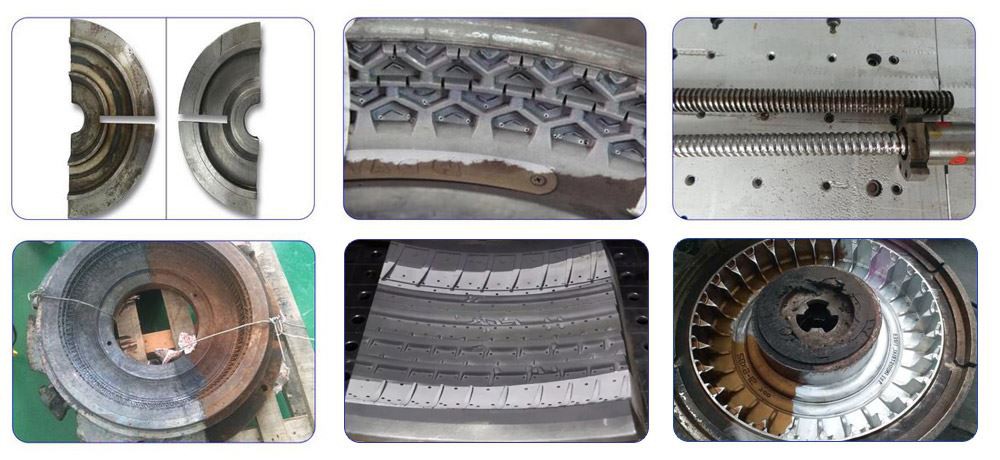
Every year, tire manufacturers all over the world manufacture hundreds of millions of tires. In the production process, the cleaning of tire molds must be rapid and reliable to save downtime. Traditional cleaning methods include sandblasting, ultrasonic, or carbon dioxide cleaning, but these methods usually must be moved to the cleaning equipment for cleaning after the high heat mold is cooled for several hours.
The cleaning takes a long time and is easy to damage the accuracy of the mold. Chemical solvents and noise will also produce problems such as safety and environmental protection. Using laser cleaning method, easy to use; Since the rubber is not gasified, it will not produce toxic gas and affect the safety of the working environment, the benefits obtained in saving standby time, avoiding mold damage, working safety, and saving raw materials can be quickly recovered.
According to the cleaning test of the laser cleaning equipment on the production line of the tire company, it can clean a set of large truck tire molds online in only 2 hours. Compared with conventional cleaning methods, the economic benefits are obvious.
Application of Laser Cleaning in Steel Rust Removal
The general method of steel cleaning in China is pickling, which seriously pollutes the environment. Laser cleaning solves this problem well in this regard and is a green method.

Precise de ester cleaning in the precision instrument industry
In the precision machinery industry, it is often necessary to remove esters and mineral oils used for lubrication and corrosion resistance on parts, usually by chemical methods, and chemical cleaning often still has residues. Laser desertification can completely remove esters and mineral oil without damaging the surface of parts.
Application of Laser Cleaning in Medical Instruments and Repair
When it comes to laser cleaning, many people will think of washing tattoos. It uses CO2 or Nd: YAG pulsed laser to clean the surface, remove pigmentation, improve the appearance of scar tissue (incurable), and restructure the outer layer of the skin without damaging the outer layer, as shown in the table below.

In fact, it is used in a variety of medical specialties, including ophthalmology, general surgery, neurosurgery, otolaryngology, dentistry, oral and maxillofacial surgery, and veterinary medicine. Laser scalpels are used to ablate hard and soft tissues.
Application of Laser Cleaning in and Equipment
Laser cleaning technology is widely used in weapon maintenance. The laser cleaning system can remove rust and pollutants efficiently and quickly, and select the removal parts to realize the automation of cleaning.
The cleanliness is higher than that of the chemical cleaning process, and there is almost no damage to the object's surface. Without pollution, it can also be operated remotely, which effectively reduces the health damage to operators.
Application of Laser Cleaning in Old Aircraft Paint
The surface of the aircraft needs to be repainted after a certain period of time, but the original old paint needs to be completely removed before painting. The traditional mechanical paint removal method is easy to damage the metal surface of the aircraft and bring hidden dangers to safe flight.
If multiple laser cleaning systems are used, the paint layer on the surface of an A320 Airbus can be completely removed within two days without damaging the metal surface.
Application of Laser Cleaning in Building Exterior Walls
With the rapid development of China's economy, more and more skyscrapers have been established, and the problem of building exterior wall cleaning is becoming more and more prominent. The laser cleaning system provides a good solution to the cleaning of building exterior walls through optical fiber.

It can effectively clean all kinds of pollutants on all kinds of stone, metal, and glass, and the cleaning efficiency is many times higher than that of conventional cleaning. It can also remove black spots and color spots on various stone materials of buildings
Application of Laser Cleaning in the Electronic Industry
The electronic industry uses the laser to remove oxides: the electronic industry needs high-precision decontamination, which is especially suitable for laser to remove oxides. Before welding the circuit board, the component pins must be completely deoxidized to ensure the best electrical contact, and the pins must not be damaged during the decontamination process. Laser cleaning can meet the use requirements, and the efficiency is very high. One pin only needs to irradiate the laser once
Application of Laser Cleaning in Reactor of Nuclear Power Plant
The laser cleaning system is also used to clean the pipes in the reactor of the nuclear power plant. It uses optical fiber to introduce a high-power laser beam into the reactor to directly remove radioactive dust, and the cleaned materials are easy to clean. Moreover, due to the remote operation, the safety of staff can be ensured.
To sum up, laser cleaning plays an important role in many fields, and can play an important role in automobile manufacturing, semiconductor wafer cleaning, precision parts processing and manufacturing, equipment cleaning, building exterior wall cleaning, cultural relics protection, circuit board cleaning, precision parts processing and manufacturing, LCD cleaning, chewing gum residue removal and other fields.